What The Bear reveals about human service, personalisation and the future of luxury experience
The Bear resonates far beyond its suspense. Its emotional force is rooted in family inheritance, dedication, psychological fragility, difficult relationships and the belief that work can become a form of generosity.
The kitchen provides the setting. The deeper subject is what people are willing to do for one another.
Some of the series’ most affecting moments are built around hospitality. In “Forks”, the team learns that a guest will leave Chicago without having tried deep-dish pizza. One is collected from across the city and transformed into an unexpected course. In a later episode, a family visits for a meal connected to a personal milestone. The team discovers two modest wishes behind the reservation and creates an experience around them, including summer snow. Without revealing the broader story, the point is the same: someone listened, understood what would be meaningful to this particular guest and cared enough to act.
These moments echo the philosophy of restaurateur Will Guidara, whose idea of “unreasonable hospitality” helped inspire the series. His best-known example began when diners regretted not having eaten a New York hot dog during their visit. A simple street-food purchase became the most memorable part of a fine-dining meal because it answered a passing human remark with precision.
Fine dining and luxury retail share exceptional craft, detailed knowledge and the promise of entering a world apart. They also share the same risk: concentrating so fully on what has been produced that the person receiving it becomes secondary.
The Bear offers a useful reminder. The experience becomes complete when expertise is placed in the service of another person.
HOSPITALITY IS CREATIVE WORK
Service is often treated as the delivery layer surrounding the product. The creation takes place in the studio, atelier or kitchen; the client-facing team presents what has already been made.
The strongest hospitality challenges that hierarchy. The front-of-house team in The Bear observes, interprets and invents. A detail is noticed, information is shared and the restaurant decides how to respond. The guest experiences spontaneity, but the gesture depends on judgement, coordination and creative freedom.
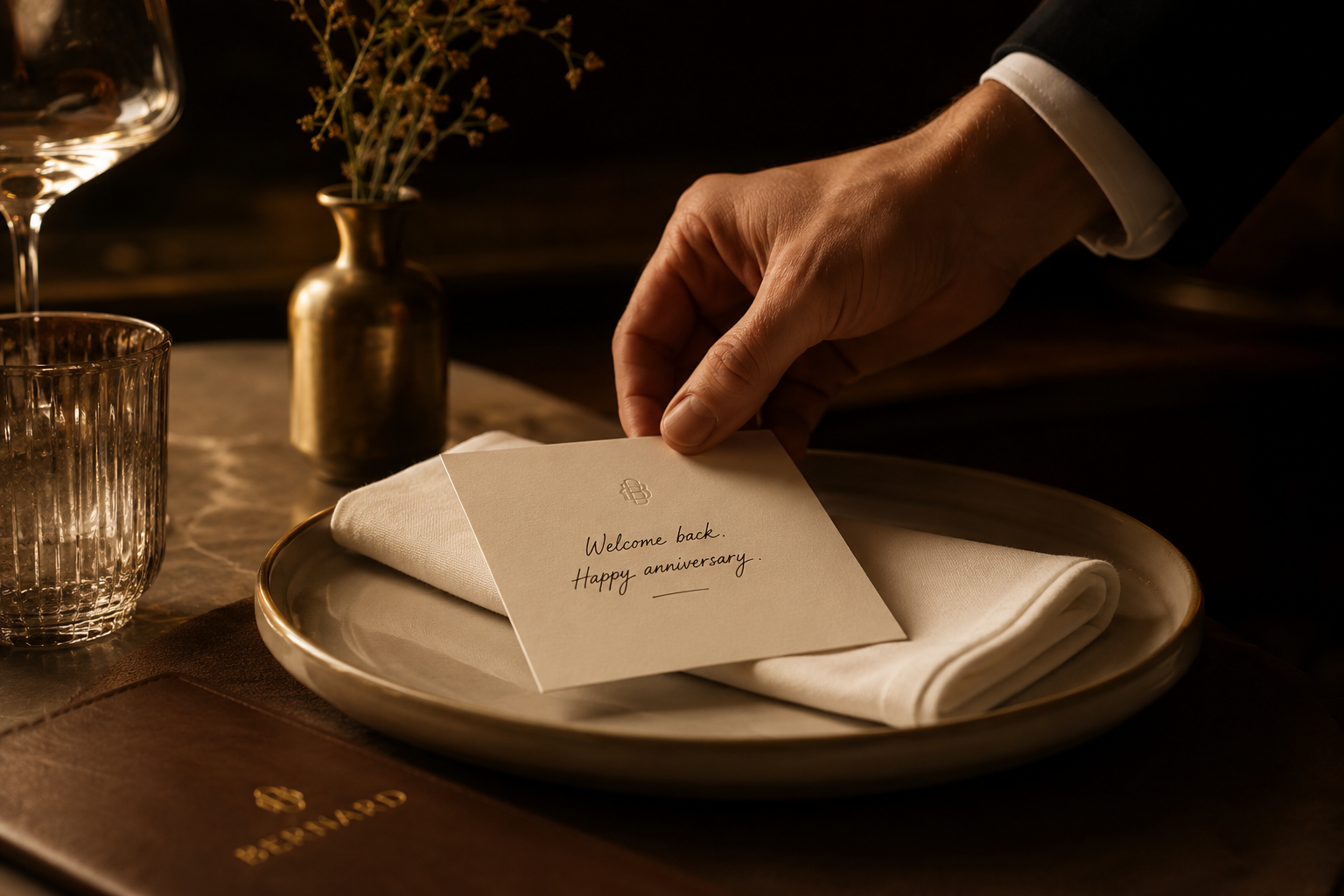
This does not require turning every encounter into a theatrical surprise. The most convincing gestures are often modest: a handwritten message acknowledging an occasion, time offered without pressure, a product selected because the advisor has understood the person rather than simply the profile.
The value lies in relevance. Luxury personalisation is frequently discussed as the multiplication of options. Its more meaningful form is the precision of attention.
BEYOND STAGING THE EXPERIENCE
Luxury houses have become highly accomplished at building physical worlds around their products. Flagships incorporate art, architecture, hospitality and cultural programming. Fashion houses operate cafés and restaurants. Exhibitions, private dinners, resort takeovers and immersive launches extend a maison into new places and occasions. As MAENA recently explored through the Summer 2026 activations of houses including Gucci, Jacquemus and Burberry, brands are increasingly turning destinations into tangible expressions of their identity.
This responds to a genuine appetite for lived experience. Euromonitor reported that physical stores represented 81 per cent of personal luxury-goods sales in 2025, while 52 per cent of high-income shoppers preferred buying fashion in-store, up from 36 per cent in 2023. Digital convenience has not removed the desire for tactility, hospitality and human exchange.
Yet there is a distinction between staging a world and hosting a person inside it.
Architecture cannot compensate for an uncertain welcome, an advisor who assesses purchasing power before offering attention, a generic presentation or a relationship that disappears once payment is complete. A client may remember the installation. They will also remember how they were made to feel beneath it.
The physical experience depends on two creative disciplines. One designs the environment. The other brings it to life through thousands of daily interactions that rarely appear in campaigns.
THE FIRST LUXURY IS TO FEEL WELCOME
Luxury boutiques can be intimidating. Their silence, security and carefully controlled codes create separation from ordinary retail. This can heighten desire, but it can also make visitors wonder whether they belong or whether their capacity to spend will be evaluated before their interest is understood.
A maison should never require someone to prove their value before offering its own.
Every visitor should feel received, considered and worthy of the house’s time, whether or not a purchase takes place that day. This is not about exaggerated deference or making every person feel famous. It is about creating the ease and confidence that allow a real exchange to begin.
The visitor may be discovering the house, saving for one important purchase, choosing a gift linked to a milestone or returning to a maison associated with a parent or grandparent. Behind the visit, there is often a story that is neither commercial nor immediately visible.
The advisor’s role is to create enough trust for that story to emerge. This demands sensitivity: interest without intrusion, warmth without imposed familiarity, memory without surveillance.
A July 2026 study by McKinsey and The Business of Fashion, based on more than 2,000 luxury clients in the US and China, found emotional connection to be the leading driver of desirability in both markets. It also observed that, as brands concentrated on VIC clients during the slowdown, many lost sight of lower-tier customers and gave them fewer reasons to visit stores. The report recommends extending brand experiences beyond top-tier clients and measuring stores through relationship quality rather than immediate sales.
The point is not that every client should receive identical service. It is that the quality of attention should never be conditional on proving immediate commercial value.
PERSONALISATION BEGINS WITH A QUESTION
True personalisation begins before a recommendation is made.
Why has the client come today? Are they buying for themselves or someone else? Is there an occasion behind the visit? What relationship do they already have with the house? Are they looking for a specific object, or for help expressing something they have not yet translated into a product?
These questions should not resemble a qualification script. Their purpose is to understand the intention surrounding the purchase.
An object may signify independence, remembrance, professional recognition or continuity between generations. Product knowledge becomes more valuable when it is applied to a real life.
The sales advisor is more than the voice of a collection. They are the host and interpreter of the maison, connecting the client’s story with the object’s meaning and the house’s expertise.
This requires cultural confidence, emotional intelligence, discretion and enough autonomy to adapt the encounter. The organisation must support them. In The Bear, one person notices; another retrieves; the kitchen adapts; the front-of-house team delivers. Luxury service is equally collective. Stock, appointments, aftercare and client information cannot operate as disconnected systems if the encounter is meant to feel seamless.
TECHNOLOGY SHOULD HELP THE MAISON REMEMBER
This is where CRM and artificial intelligence can create genuine value.
A client should not have to repeat the same preferences at every appointment or feel like a stranger when entering another boutique belonging to the same house. With consent, technology can preserve useful context: sizing, materials, previous purchases, alterations, gifting relationships, significant occasions and preferred communication.
The evolution between two Bain & Company and Comité Colbert studies is instructive. In 2023, their report on the boutique of the future argued that technology should deepen the relationship between clients and sales advisors, improve expertise and remove friction from the visit. The principle was already clear.
The June 2026 edition shows how rapidly the context has moved. Nearly half of clients who purchased in a boutique had used AI somewhere in their shopping journey. AI assistance for client advisors is the most advanced of the report’s customer-facing applications, yet deployment with measurable impact remains limited. The industry increasingly understands what technology could enable, but has not yet translated it into consistently better relationships.
AI should not conduct the relationship on the advisor’s behalf. It should help the maison prepare more thoughtfully, remember more accurately and give teams the time and context required to respond as human beings.
The client should experience continuity, not the machinery producing it. Technology should act as the maison’s memory. The advisor remains its interpreter.
FROM A PURCHASE TO A RELATIONSHIP
The most valuable luxury relationships rarely end with the first acquisition. They continue through maintenance, repair, alterations, future additions and gifts chosen for other people. An object may later be passed to a child. A trusted advisor may accompany several important moments over many years.
Bottega Veneta’s Certificate of Craft offers a concrete expression of this continuity. Introduced in 2022 for selected iconic products, it gives access to complimentary care services intended to support their long-term use and enjoyment. The initiative reflects the house’s ethos of “value over volume”: the object is not treated as a seasonal transaction, but as something the maison remains willing to accompany through time.
Aftercare is more than a practical intervention. It allows the product to absorb the client’s own history while remaining connected to the expertise that created it. It also gives the relationship another reason to continue beyond the next launch.
This is why attention cannot be reserved only for celebrities, visible VICs or clients already identified as major spenders. These relationships understandably receive dedicated programmes, but the future collector, the quieter client and the family connection that may develop over decades also matter.
A no-purchase visit can create confidence, future consideration and recommendation. Its value may not appear in same-day conversion, but it can shape how the house is remembered.
REVALUING THE ORDINARY ENCOUNTER
Luxury leaders invest significant time in designing extraordinary moments. The ordinary moments taking place in boutiques every day deserve comparable strategic attention.
Was the visitor acknowledged naturally? Did the advisor understand the purpose of the visit? Did the presentation become more precise as the conversation developed? Was a no-purchase client allowed to leave without pressure? Did the follow-up refer to something specific? When the client returned, did the relationship continue?
These questions are less visible than event attendance, social reach or sales per square metre. They are also central to long-term desirability.
Houses should examine whether their performance systems allow teams to practise hospitality properly. When advisors are assessed almost exclusively on immediate sales, time spent with a future client can appear inefficient. When every gesture requires approval, spontaneity disappears. When staffing is insufficient, even an excellent advisor must choose speed over care.
The challenge is organisational as much as emotional. Teams need time to listen, relevant information, cultural awareness and autonomy. A house cannot ask for deeply personal experiences while rewarding only short-term transactions.
THE LUXURY OF BEING REMEMBERED
What makes the hospitality in The Bear so moving is the transformation of attention into action. A comment is heard. A reason for visiting is understood. The team applies its creativity and knowledge to making another person’s experience more joyful. Their expertise has reached someone.
Luxury houses possess extraordinary products, histories, spaces and creative resources. They know how to make people dream from a distance and how to build physical worlds that attract attention. Their next opportunity is to bring the same ambition to the encounter that happens once the client steps inside.
A memorable experience does not always require a private dinner, an artistic installation or an impossible surprise. It may begin with a sincere welcome, a question asked with genuine interest or a detail remembered at precisely the right moment.
The experience starts before the product is presented and continues after the client has left.
Luxury is felt when someone realises that the maison has truly seen them. Loyalty begins when they return and discover that it has remembered.
Marine Moureaux-Gall / MAENA Agency
Featured image credit: AI-generated editorial visual, art-directed by MAENA Agency.