Theme: Summer 2026 luxury campaigns
Summer is the one season when almost every premium brand reaches for the same visual vocabulary — sun, sea, stripes, terracotta light. It is also, for that reason, one of the clearest tests of singularity, and this year the pattern has had a full season to play out: some campaigns opened as early as May and are still running, others joined as recently as this month, and the beach-club playbook alone is now in its ninth consecutive summer. What a house builds on top of the shared codes — whether it launched eight weeks ago or eight days ago — is what reveals a genuine point of view rather than a mood board. A look across this season’s campaigns and activations — from the Riviera to Monaco to the Aegean, from travel retail counters to a fragrance bottle — surfaces three distinct strategies for standing apart, and one question every house in the category is quietly wrestling with.
A CODE MADE PORTABLE — DIOR AND BOTTEGA VENETA
Dior’s Dioriviera Summer 2026 collection returns to the French coastline the house has claimed as its own territory for several seasons — but this year’s chapter, shot by photographer Gray Sorrenti, deliberately steps away from the sun-drenched postcard. The images unfold at a slower rhythm, model Sandro Vep captured with a quality that is languid rather than triumphant, set against refined interiors as much as raw landscape.
For the makeup line, Deva Cassel fronts a campaign staged at La Colle Noire, Christian Dior’s own former estate in Provence — and its real signature is not a stripe but a flower. The couture Dior Daisy motif appears across the makeup range for the first time, with daisies blooming across a palette of dusty rose and azure blue, quietly tying a seasonal launch back to the marguerites of the founder’s own garden rather than to a generic idea of the coast. The tone matters as much as the palette: the film is styled as an unhurried day among friends — soft, joyful, deliberately escapist — and that register is doing real work. After several years in which luxury beauty campaigns have leaned serious and sculptural, a film built around lightness and permission to have fun reads as a reset aimed squarely at a younger audience. Shared codes become distinctive the moment they are rooted in a specific, ownable story rather than a universal fantasy.
Bottega Veneta pushes the same logic into new territory, and did so only weeks ago. Its Alta fragrance collection, launched in early June, translates the house’s Intrecciato leather weave into scent: each of the ten fragrances pairs one Italian ingredient with one sourced elsewhere, an “Intrecciato duo” built the same way as the bag itself. The travel-format editions are, if anything, the most telling detail — pared down in size but not in design, carrying the same sculptural glass and gold-finished detailing as the full bottle, with none of the usual shortcuts travel sizes take. It is a strong candidate to become an icon in its own right, and the freshest proof that a house’s most identifiable code does not have to stay in one category, or even one format, to keep building equity.
THE BEACH CLUB AS OWNED TERRITORY — GUCCI, JACQUEMUS, DOLCE & GABBANA, BURBERRY, AMOUAGE
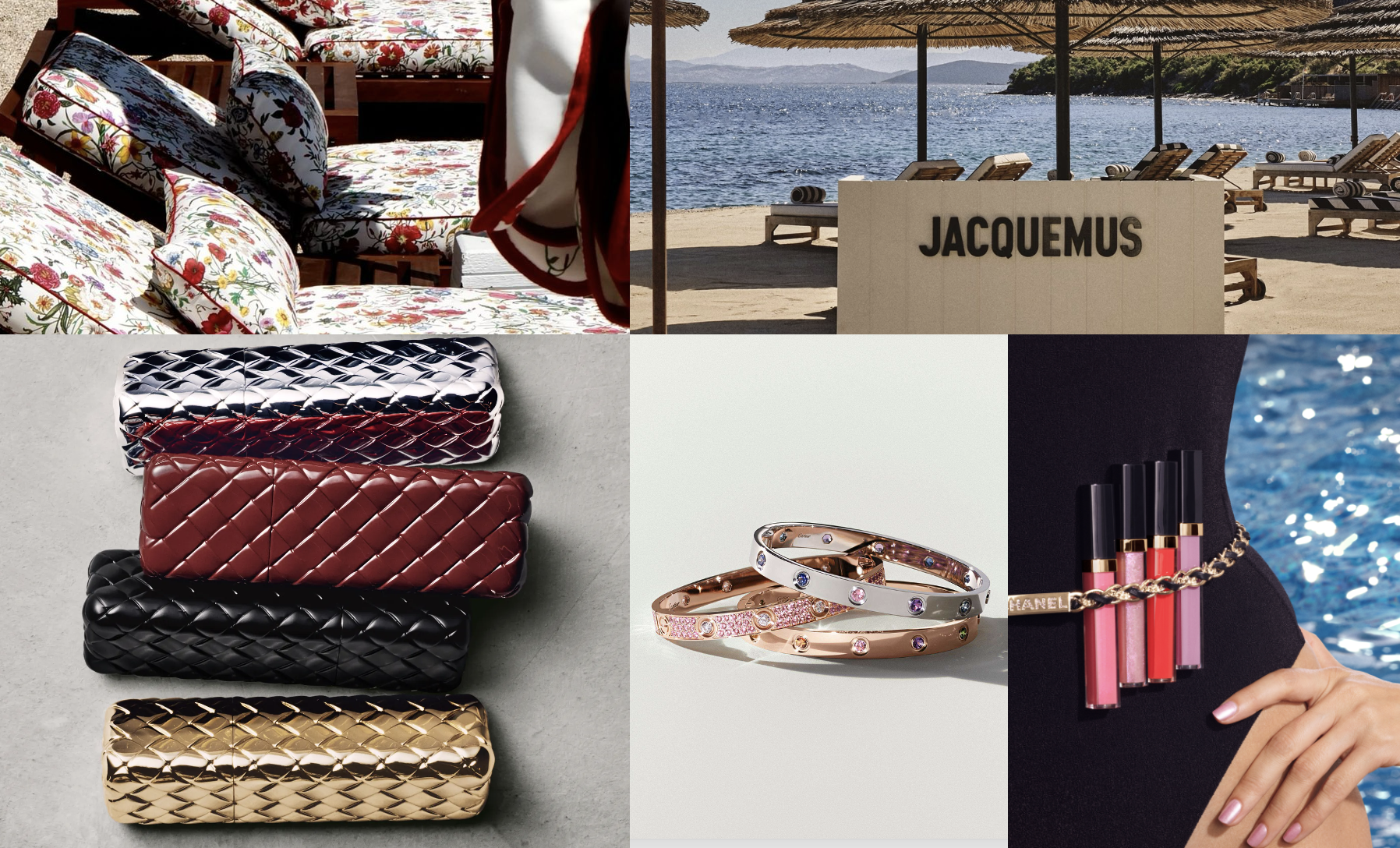
A second, more physical strategy: several houses are no longer content to campaign about summer — they are building it. Gucci has returned to La Rose des Vents in Monte Carlo for a sophomore creative takeover marking the 60th anniversary of the Flora motif, the print created in 1966 as a personal gift to Princess Grace of Monaco. Printed sunloungers, scalloped parasols and a floral installation by artist Mark Colle turn a public beach club into a legible extension of the brand’s own history, rather than a backdrop borrowed for the season.
Jacquemus has gone further still, opening a boutique inside the Mandarin Oriental Bodrum and taking over its Blue Beach entirely — this time in a graphic black-and-white stripe, notably not the sun-bleached colour and pastel the house is usually associated with, a reminder that even the boldest houses vary their own formula rather than repeat it identically. The takeover includes personalised backgammon, paddleboards and buggy rides tied to the Resort 2026 Plage collection. Dolce & Gabbana is pursuing the same logic at scale, expanding its network of branded beach clubs from Casa Amor in Saint-Tropez to a takeover of Cala di Volpe in Sardinia. The newest to join is Burberry, which checked into One&Only Aesthesis on Greece’s Athenian Riviera in mid-June, its house check reworked in turquoise across the pool, the gardens, the padel courts and even the resort’s boats.
The format is no longer confined to fashion houses, or even to luxury. Amouage — an Oman-rooted niche perfumer with no history of resort takeovers — dressed a terrace in scarlet loungers and parasols at Nobu Marbella this summer to launch its Love Hibiscus fragrance, alongside iced hibiscus drinks and in-terrace fragrance masterclasses. Further out still, Alo Yoga chartered a superyacht as an invitation-only “Wellness Club at Sea” off Cannes and took over the Hôtel Martinez pier with forty custom sunbeds during the film festival — a California activewear brand running the same seasonal playbook as Gucci and Dolce & Gabbana. This only works, for any of them, if a house’s codes — stripes, a signature floral, a specific colour — are distinctive enough to survive being blown up to the size of a beach, and, increasingly, to survive being borrowed by brands that never claimed those codes to begin with.
THE QUIET RITUAL — LANCÔME AND CHANEL BEAUTY
Not every brand is building a stage; some are building a habit. In travel retail, Lancôme’s summer push is built around “In the Mood for Summer? Three Mists, One Mood” — the Les Ô Juicy Hair & Body Mists, each tuned to a different state of mind, from Ô Oui’s euphoria to Ô Cool’s calm, designed to be reapplied through the day rather than revealed once. The mists are pitched squarely at a younger audience, many of them meeting the house for the first time through an accessible travel format rather than a signature eau de parfum. It is a reasonable bet in markets where fragrance habits are shifting toward softer, more frequently refreshed scent — but not a universal one: in the Middle East in particular, where heat and intensity of projection have always gone together, oud-based and heavily concentrated fragrances remain the summer preference, not the atmospheric mist. The lesson is less about one trend than about knowing which market, and which generation, a campaign is actually built for.
Chanel’s read on the same idea spans its usual three-axis beauty routine — fragrance, makeup and skincare together, not a single hero launch. Makeup is the most eventful of the three, and even there it is a deliberate mix rather than one single novelty: a new Rouge Coco Hydra Gloss and a new Les Beiges eyeshadow palette sit alongside limited-edition pieces like the Duo de Baumes and a Noir Allure mascara shade, layered onto otherwise standing, ongoing shades. Skincare and fragrance lean on existing products instead — the Summer Beauty skincare duo (a cream-to-foam cleanser and a rebalancing micro-serum) and the fragrance selection (N°5 L’Eau, Bleu de Chanel, Coco Mademoiselle, Chance Eau Splendide) are simply restyled as “solar, fresh and luminous” for the season, not reinvented. It’s a deliberate split — spend the novelty budget on makeup, where new and limited-edition formats actually get noticed, and let skincare and fragrance carry the season on recognition alone. What this comes back to is a simple principle: a summer campaign builds the most lasting brand equity when it feels proprietary — something that could only belong to this house. Here, the pool, the pastels and the watery light are shared territory this summer, worn by quite a few brands at once. A ritual built across an entire routine is still harder to copy than a single seasonal shade, and there is always room for the signature underneath it to become a little more unmistakably its own.
THE REAL QUESTION: HOW MUCH ORIGINALITY CAN SUMMER AFFORD?
Taken together, these campaigns map three ways to use summer to build brand equity rather than simply decorate the calendar: root a shared code in an ownable story, as Dior and Bottega Veneta do; turn a physical location into legible brand territory, as Gucci, Jacquemus, Dolce & Gabbana, Burberry and now Amouage and Alo Yoga do; or embed the brand into a daily ritual the client repeats without prompting, as Lancôme and Chanel do.
None of this answers the harder question the category is quietly sitting with. Summer is rarely a house’s most commercially decisive season, and yet it now demands a visible, well-executed campaign every year — a cost that is easier to justify than to prioritise. And because “summer” has narrowed, culturally, to a fairly small set of codes — French Riviera, the pool, the beach club, sun and colour — every house reaching for them risks looking like every other house. Skip the codes and risk feeling absent from the conversation; play them exactly as they were played the last five years and risk feeling interchangeable. Neither the safe move nor the obvious move fully answers it.
The two examples in this piece that come closest to an answer are the ones that changed the terrain rather than the decoration on top of it — and one of them is a paradox worth naming out loud. Bottega Veneta did not build a beach club at all: it built a product, and let its own weave and craft carry the story into an entirely new category. On its face, that is the least original move available — going back to the product is the default, not a fresh idea. But when every other house is competing for the same pool and the same stretch of coastline, opting out of the setting altogether and building equity through the object itself becomes its own form of differentiation. Sometimes the most original thing a house can do is stop competing on location entirely.
Loro Piana, shooting its Spring/Summer 2026 campaign at La Colombe d’Or and the Fondation Maeght in Saint-Paul-de-Vence, stayed in the Mediterranean but told the story through art and family heritage rather than a pool. Both locations carry real cultural weight of their own: La Colombe d’Or is the legendary inn where Picasso and Matisse used to trade paintings for a meal, and the Fondation Maeght nearby holds work by Braque, Miró, Léger, Giacometti, Chagall and Picasso. Loro Piana is also six generations into its own story — the same Piedmont family still rooted in the wool and cashmere craft it has practised since 1924. The campaign is not borrowing prestige from a beach club; it is placing the house’s own material culture and family patronage next to another one that already exists. Both campaigns are, technically, still “doing summer” — but neither needed a palm tree, a striped umbrella, or a beach club to do it.
That is probably the real answer to whether new launches or best-sellers should carry the season, and whether the Mediterranean and the pool seem to be mandatory: neither the product nor the location is what needs to be new. What needs to be specific is the story attached to them — a garden, a weave, an atelier, a founder’s own address — because that is the one thing a competitor cannot license, borrow, or recreate at the beach club next door. Making the client dream is still the job. Doing it in a way that is unmistakably, ownably the house’s own is what turns a summer campaign into desirability that lasts past August.
A SIGNAL WORTH WATCHING
One pattern holds across nearly every launch in this piece: the classic luxury houses are working almost entirely in pastel and glow this summer. Colour is starting to push back in from the edges, in categories that rarely move this fast. Cartier’s Love Colour capsule sets pink sapphires, tsavorites, amethysts and tanzanites into the LOVE bracelet — an archetype the house changes rarely and carefully — as a deliberate, tightly limited dose of colour on its most codified object. At Galeries Lafayette, Memo Paris turned its counter into Villa Soleil, a saturated, Riviera-toned pop-up built around a limited-edition fragrance launch — a shot of bold colour that read as a relief next to the pastel campaigns filling every other counter this summer. And the generation just behind today’s luxury customer is moving the same direction: Gen Alpha is reaching for loud, saturated colour especially in makeup, the visual opposite of the “clean girl” aesthetic that has defined the last few years. Three different categories, three different generations, one direction. Whether the luxury houses lean into it, resist it, or split the difference is a subject for a coming post.
Marine Moureaux-Gall / MAENA Agency