Theme: Paris Haute Couture Week 2026 (2/2)
Paris remains couture’s institutional capital. The creative authority it convenes, however, is increasingly distributed across cultures, craft traditions and emerging luxury ecosystems.
Paris Haute Couture Week has always been international in its clientele, its influence and its ambitions. What feels different this season is the degree to which that internationalism is visible inside the calendar itself.
Across the first two days of the Autumn/Winter 2026–2027 season, Schiaparelli, Dior and Chanel appeared alongside Imane Ayissi, Georges Hobeika, Rahul Mishra, ArdAzAei and Ashi Studio. These houses do not form a single movement, and their work cannot be reduced to a shared ‘non-Western’ identity. They come from distinct histories, operate through different ateliers and carry very different creative languages. What connects them is more structural: creative authority in couture is no longer flowing primarily from a Western centre towards the rest of the world.
Paris remains the place where couture is most rigorously framed, recognised and amplified. Yet the sources shaping its future are becoming more widely distributed. This is not a decline in Parisian influence. It is a change in the nature of that influence, from defining couture through a predominantly European tradition to convening a wider geography of excellence.
A CALENDAR THAT ALREADY LOOKS DIFFERENT
The official calendar offers the clearest starting point. Haute Couture Week runs from 6 to 9 July 2026 and distinguishes three institutional categories: accredited Haute Couture Members, Corresponding Members whose ateliers are based outside France, and Guest Houses selected season by season by the Haute Couture Committee.
The distinction matters. Chanel, Dior and Stéphane Rolland sit within the accredited core. Giorgio Armani Privé and Elie Saab appear as Corresponding Members. Rahul Mishra, Imane Ayissi, Ashi Studio, Georges Hobeika and ArdAzAei are Guest Houses. Their presence is official and highly visible, but it does not confer identical institutional standing.
This layered structure captures the current moment with unusual precision. Paris has opened its most prestigious platform to a broader range of creative traditions, while retaining the authority to decide who enters, under which status and for how long. The city is more plural; the institution remains selective.
That selectivity is part of couture’s value. Without it, the calendar would lose the rigour that gives participation meaning. Yet the composition of the guest list now reveals something larger than seasonal novelty. Several of these houses have returned across successive seasons, developing recognisable bodies of work and building relationships with international clients, media and partners. They are no longer peripheral additions to a Western narrative. They are contributing to shape the narrative itself.
WHEN HERITAGE BECOMES CREATIVE INFRASTRUCTURE
Rahul Mishra’s Devi collection made this shift particularly visible. The designer translated ancient Indian sculpture and temple carving into contemporary couture, working with stone-like surfaces, sculpted bodices, embedded jewellery effects and handwork that treated the body almost as living architecture.
The strength of the collection did not come from an ‘Indian influence’ added to a familiar couture silhouette. Its references shaped the entire creative system: the materials, the surface development, the construction, the pace of production and the labour behind each piece.
That distinction is essential. Cultural depth in luxury is often discussed through imagery, motifs and storytelling. Mishra demonstrates a more substantial model. His house connects creative expression with an atelier structure that supports more than 1,000 artisans and positions embroidery, weaving and handwork as forms of economic and cultural continuity. The source of value is therefore visible in both the object and the system that produces it.
Imane Ayissi approaches the question through a different language. The Cameroonian designer has built an independent couture house around the meeting of African cultural heritage, Parisian construction and artisanal craftsmanship. His work brings raffia, handwoven textiles and African draping traditions into dialogue with French couture technique.
This is culture as embodied knowledge, entering the institution on its own terms. The materials carry histories. The techniques come from communities and practices that predate their appearance in Paris. The designer’s authority comes from understanding how to translate them without flattening their origin or freezing them as heritage objects.
For luxury, the strategic implication reaches beyond couture. As global clients become more knowledgeable and more attentive to provenance, a cultural reference is persuasive only when it is supported by genuine expertise, relationships and production choices. The difference between borrowing a visual code and building from a living tradition is increasingly easy to recognise.
CREATIVE EXCHANGE NO LONGER TRAVELS IN ONE DIRECTION
A more plural couture geography should not confine designers to representing their country of origin. Ashi Studio is instructive precisely because Mohammed Ashi moved in the opposite direction.
For A Different Skin, the Saudi designer explored identity, concealment and transformation through references spanning Renaissance Florence, Venetian masquerade and historical court dress. Feathers, sculptural corsetry, shell-like volumes, painted Japanese paper and gilded objects created figures somewhere between human, bird, insect and artefact.
The collection did not ask to be read as an expression of ‘Saudi style’. Ashi drew freely from European history and transformed it through his own construction, proportion and theatrical instinct. That freedom is significant. Western fashion has long treated the world’s visual cultures as available creative material. A genuinely plural system also allows designers from outside Europe to interpret European history without being treated as visitors to it.
Stéphane Rolland’s tribute to Dalida offered another form of cultural movement. The collection followed a life shaped by Cairo, the Mediterranean and Paris, translating those geographies into sculptural whites, deep crimson, black, silver and materials chosen for emotional force. The result was not a neat national story. It reflected an identity formed through movement, reinvention and several cultural worlds at once.
This is closer to how contemporary luxury is actually lived. Designers, craftspeople and clients rarely inhabit one cultural territory in isolation. The most interesting work does not simply place one tradition beside another. It allows references to move, while preserving enough knowledge and authorship for the exchange to remain credible.
WHAT A PLURAL GEOGRAPHY ASKS OF WESTERN HOUSES
The rise of creative authority beyond the traditional Western centre does not require European houses to become defensive, or to accumulate external references in order to appear global. The stronger response is deeper self-knowledge.
At Chanel, Matthieu Blazy built his second couture collection from a book of fairy tales found in Gabrielle Chanel’s apartment. Guipure suggested climbing beans; vines entered shoes and dresses; minaudières became sleeping bears; embroidered linings and hidden details brought fantasy into the private experience of the garment. The collection renewed the house by returning to a precise internal source and interpreting it with freedom.
This is an important counterpoint. In a wider creative field, heritage does not become less valuable. Generic heritage does. The more distinctive the voices entering couture become, the less convincing it is for an established house to rely on prestige, archive references or craftsmanship as abstract claims.
Western houses still possess extraordinary advantages: atelier knowledge, institutional recognition, client relationships and archives built over decades. Their opportunity is to use those advantages with greater imagination. A broader couture world can sharpen the established centre by raising the level of comparison.
The healthiest outcome is therefore not a contest in which one geography replaces another. It is a creative environment in which each house must articulate why its language matters, what knowledge it protects and how it can evolve without dissolving into the global visual mainstream.
FROM INVITATION TO INSTITUTION
Visibility in Paris is powerful, but it is only one stage in the construction of a global luxury house. The longer-term test lies in infrastructure.
Reliance Brands and Rahul Mishra formed a joint venture to build a global ready-to-wear brand around the designer’s universe, later unveiled as AFEW Rahul Mishra. In April 2026, Kering announced a strategic partnership with ICCF and a minority investment intended to support the international expansion of ICICLE, the Shanghai-founded house operating more than 200 stores, including a Paris flagship.
ICICLE is not a couture house, but the investment belongs to the same geographical shift. International groups are beginning to look beyond established European and American names for brands with their own cultural foundation, operational depth and potential to travel globally. Distinctiveness rooted in another geography is becoming an asset to develop, rather than a local characteristic to smooth away.
The danger is that international expansion may reproduce the standardising pressures that have weakened singularity elsewhere in luxury. A house can gain distribution and lose the specific rhythm, material intelligence or local network that first made it valuable. Capital must therefore support the source of authority rather than replace it with a more familiar global template.
For the guest houses of the couture calendar, the developments worth monitoring are concrete: continuity of presence, evolution of institutional status, strength of the atelier, international distribution, product architecture, access to investment and the ability to create recognisable signatures beyond the showpiece gown.
A celebrated collection can attract attention. A lasting house requires governance, transmission and the discipline to turn cultural authority into a coherent brand without reducing it to a marketable symbol.
PARIS AT THE CENTRE OF A WIDER WORLD
Paris is not ceasing to be the centre of couture. No other city currently combines the same institutional structure, technical expectations, media concentration and historical authority. Its continuing power is visible in the fact that ambitious designers from across the world still choose to show there.
The more consequential change is that Paris no longer represents the only legitimate origin of couture imagination. Indian embroidery communities, African textile traditions, Lebanese and Gulf ateliers, East Asian material experimentation and hybrid creative identities now arrive with their own systems of knowledge. They are not simply contributing colour to an existing European framework. They are expanding the framework.
For the houses historically established at the centre, this should be read as creative stimulus. Luxury progresses when excellence encounters another form of excellence, when inherited methods are tested by unfamiliar ideas and when designers are required to move beyond the safety of recognised codes.
The future of couture may remain institutionally Parisian while becoming culturally and creatively more distributed. Paris will protect its relevance by holding these two truths together: maintaining the standards that make couture exceptional, and allowing distinct traditions to enter without being flattened into a single global language.
A stronger centre does not need to speak alone. It needs to recognise when the conversation has become larger than itself. It’s called complementarity.
Marine Moureaux-Gall / MAENA Agency
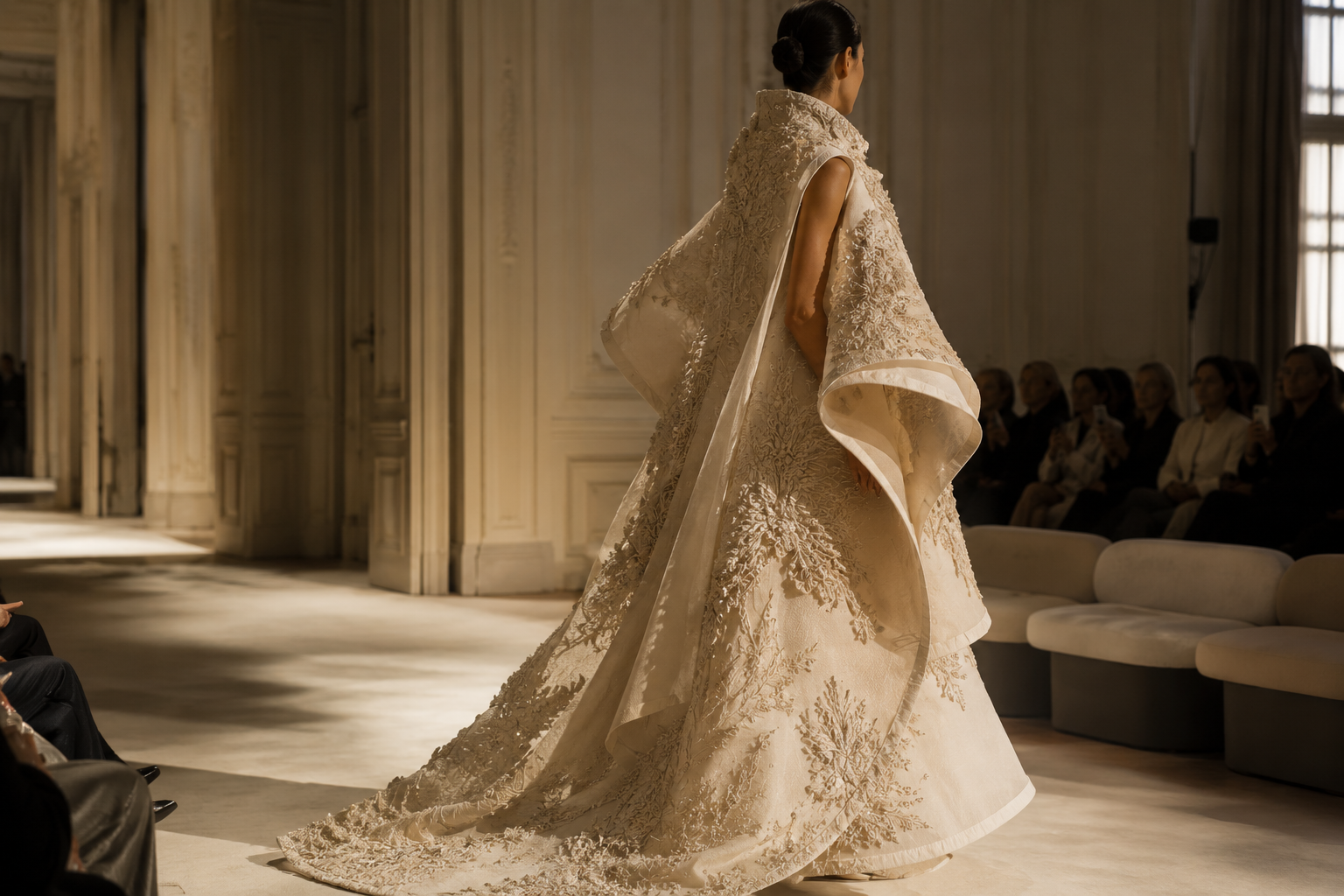
Featured image credit: AI-generated editorial visual, art-directed by MAENA Agency.