Theme: Paris Haute Couture Week 2026
Paris Haute Couture Week opens today, July 6, and runs through July 9. Couture remains the sector’s most concentrated expression of what luxury says it believes in: time, rarity, technical mastery, creative freedom and the value of the human hand. This season carries unusual symbolic weight. Major houses are entering decisive creative chapters, new guest names are widening the calendar, and the wider luxury market is only beginning to stabilise after one of its most difficult periods in years.
Bain’s June 2026 update describes a market racing to rebuild relevance and meaning; McKinsey’s new State of Luxury report, based on more than 2,000 clients in the US and China, shows that desirability, exclusivity, moments and discovery are increasingly fragmented by market. The client is still looking for exceptionalism, but no longer reads it through one universal lens.
This is the real backdrop to couture week. Luxury cannot simply follow trends without weakening the continuity on which its authority rests. But it cannot ignore its own time either. The question is how maisons preserve aura while responding to younger generations, different cultural expectations, new forms of discovery, stronger demands for experience and an AI-shaped environment in which polished imagery is abundant.
COUTURE AS A RESPONSE TO A MORE FRAGMENTED LUXURY WORLD
Couture offers a powerful response because it concentrates several things clients increasingly struggle to find elsewhere: visible expertise, singularity, human relationship, exclusive experience and cultural depth. Its role is not primarily one of volume. It creates authority that can travel into leather goods, beauty, jewellery, private client relationships and the wider world of the house.
The challenge is translation. A Chinese client discovering a maison through digital ecosystems, a younger American client looking for cultural relevance and a long-standing European private client may not read exclusivity in the same way. McKinsey’s research makes that divergence particularly clear. The strongest houses will remain recognisable across these contexts without flattening them into one global campaign.
This is why the shows should be read as more than spectacle. Which ideas can become durable codes? Which techniques can deepen the perception of value? Which creative propositions can travel into product and experience without being mechanically commercialised? In a market where years of price elevation have made clients more attentive to the price-value equation, cultural ambition has to reinforce the credibility of the whole house.
THE HOUSES TO WATCH — AND WHAT THEIR CHOICES MAY REVEAL
Several creative chapters make this week a particularly clear test. Pierpaolo Piccioli will present his first couture collection for Balenciaga — his first for the house, after years of couture experience at Valentino. The question is how he negotiates Cristóbal Balenciaga’s architectural legacy with his own language of colour, volume and emotion. At Jean Paul Gaultier, Duran Lantink’s first couture collection opened another question: can provocation become a durable house language after the guest-designer era? He will continue his run for the Maison this week.
At Dior and Chanel, the second couture collections by Jonathan Anderson and Matthieu Blazy may be even more revealing than the debuts. A first show announces intention; a second begins to prove whether a language can endure. Watch which codes are repeated, refined or abandoned.
The guest houses widen the lens. Indian designer Manish Malhotra brings a background connecting exceptional occasion dressing, Bollywood image-making, bridal culture and India’s deep traditions of handcraft. His presence asks whether Paris can remain the centre of couture while becoming more genuinely receptive to other cultures of exceptional dress. Standing Ground, founded by Irish designer Michael Stewart, brings a different proposition: sculptural, body-led draping shaped by hand-making and an Irish sensibility. In a market where expectations differ sharply by region, these additions are strategically significant, not peripheral.
CHANEL, CHARVET AND THE VALUE OF BUILDING CAPABILITY
One of the most interesting signals arrived before the first look walked. Days before Matthieu Blazy’s second couture show, Chanel acquired Charvet, the historic Paris shirtmaker founded in 1838. The move follows an existing creative dialogue between Blazy and Charvet and has been presented as a way to preserve rare French artisanal know-how while maintaining the shirtmaker’s creative independence.
The timing is resonant. In a difficult economic context, this is a maison investing in the capability behind creation, rather than simply borrowing the image of craft for a season. It offers a constructive counterpoint to the pressure for constant novelty. Enduring luxury may depend on knowing where to adapt and where to deepen. Chanel is moving through a new creative chapter while securing a historic savoir-faire: movement grounded in its heritage.
BEYOND THE RUNWAY: CULTURE, EXPERIENCE AND NEW FORMS OF EXCLUSIVITY
The wider couture ecosystem is becoming as revealing as the runway. Vogue’s July 2026 guide points to high-jewellery presentations, the “Azzedine Alaïa and Africa” exhibition, a Martin Margiela archival auction supporting AIDS research and the Sidaction Dîner de la Mode. The official programme also includes experiences such as Roger Vivier’s L’Atelier des Papillons where the Maison will present its Pièce Unique FW26 collection.
These are not secondary details. Luxury clients increasingly expect more than possession: exhibitions, private appointments, cultural associations, exceptional hospitality, philanthropy and private access to expertise create different forms of proximity. Luxury remains selective, but the relationship is less purely top-down. Clients interpret, participate, travel, discover through communities and compare experiences across sectors.
The distinction is cultural credibility. An exhibition can build understanding; a private event can strengthen belonging; a philanthropic initiative can reveal values through action. The strongest associations grow from the house’s own worldview and contribute something credible to the culture around them, with profound meaning. Used superficially, the same formats become another layer of content. This is precisely why cultural significance is becoming part of competitive advantage.
THE HUMAN HAND IN AN AI-SHAPED ERA
Couture also arrives as AI changes how clients discover, compare and imagine products. Bain notes the growing role of AI in luxury discovery and comparison. This makes the human hand more visible and strategically important.
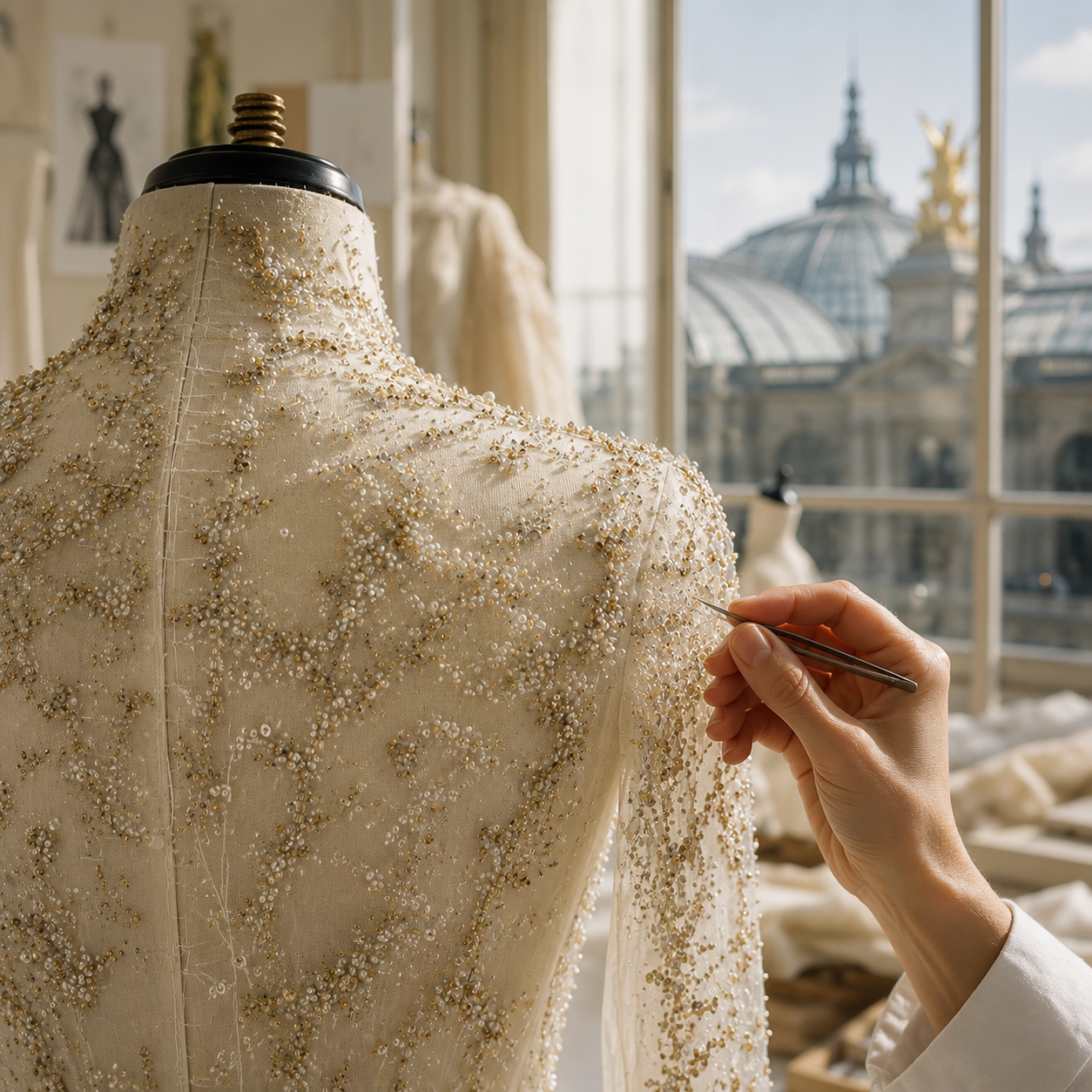
The opportunity is complementary. AI can help a house explore archives, improve clienteling, translate knowledge across markets and support personalisation. Couture shows where embodied expertise remains decisive: a fitting adjusted by eye, material knowledge accumulated over decades, the dialogue between client, designer and atelier, the judgement to know when a detail changes the whole.
In an environment of abundant generated imagery, evidence of real making gains cultural weight. The houses that respond best will not position technology and craft as enemies. They will use technology to reveal, support and extend what human expertise makes possible.
THE QUESTION HOUSES SHOULD TAKE FROM THIS WEEK
The most useful way to read the next four days is therefore to look beyond a ranking of spectacular moments. Watch Balenciaga and Jean Paul Gaultier for the translation of new creative leadership into durable codes. Watch Dior and Chanel for the second-step discipline that follows a debut. Watch Manish Malhotra and Standing Ground for signs that couture’s cultural grammar is genuinely broadening. Watch high jewellery, exhibitions and private experiences for evidence that houses are building richer client journeys. Watch Chanel after Charvet for a model of investment in capability rather than novelty alone.
And watch the translation across the entire house. Which runway ideas can travel into an accessory, a store, a private appointment, a beauty image or a cultural programme without becoming diluted? Which houses make expertise easier to understand without making it ordinary? Which experiences create belonging while preserving distance? Which uses of technology strengthen human relationship rather than automate it away?
The sector is facing a rare conjunction: weaker growth, geopolitical uncertainty, more selective clients, regional fragmentation, generational change and technologies that accelerate both discovery and sameness. For houses with extraordinary heritage, the answer cannot be permanent reinvention. Preserving every established way of working is unlikely to be sufficient either.
The more promising path is adjustment with conviction: understand that exclusivity is read differently across cultures; build experiences around meaning rather than spectacle alone; use AI where it extends service and intelligence; protect the hand and the depth of expertise that technology makes more precious; invite clients into a relationship with the house without reducing luxury to participation.
This connects with a question we explored recently at MAENA around the loss of singularity in luxury branding. In a market where brands increasingly share the same codes, formats and cultural references, singularity has to be actively protected. Couture remains one of the strongest places to do that because it gives a house the space and freedom of creativity to express difference at full resolution.
The gap between cultural ambition and commercial reality is real. The constructive response is to make the connection between them more deliberate — ensuring that couture’s ideas, expertise and cultural authority deepen the entire house.
Haute Couture Week remains one of luxury’s clearest arguments for why exceptional things deserve to exist. This week, the most important signal will be whether the maisons can carry that exceptionalism into a changing world with enough confidence to evolve, and enough clarity to remain unmistakably themselves.
Marine Moureaux-Gall / MAENA Agency