Theme: The decline of modern luxury codes (1/3) – The standardization
An exploration of how luxury codes are becoming increasingly homogeneous, and what brands can do to restore creative intent.
The luxury industry is going through a paradoxical moment.
On one side, it has never been more powerful. On the other, it has never felt more homogeneous.
What we are witnessing today is not the decline of luxury itself, but the insidious standardization of its codes.
FROM CRAFTSMANSHIP TO CORPORATE SYSTEMS
Luxury was originally defined by restraint: craftsmanship, ateliers, limited production, the hand of the creator, rarity, and emotional value embedded in objects.
Today, many luxury houses belong to large corporate groups and operate within highly financialized ecosystems. Competition has intensified, global expansion has accelerated, and luxury has become a major growth industry.
In this shift, luxury has moved further away from its original essence: from creation to optimization.
WHEN KPIS SHAPE LUXURY CREATIVITY
One of the most underestimated consequences of this transformation is the way operational models influence creativity itself.
In a KPI-driven environment, success is measured through growth, performance, and short-term results. During periods of uncertainty or crisis, luxury paradoxically becomes a refuge for consumers, which further increases demand pressure.
The result is a structural acceleration: less time, higher volumes, faster cycles, and ultimately lower quality thresholds.
Creativity becomes increasingly constrained by efficiency and performance.
Retail spaces, once designed as immersive experiences, often become transactional environments. Product storytelling is compressed. Attention to detail is reduced. Experience becomes standardized.
A VISIBLE UNIFORMITY ACROSS LUXURY BRANDS
This systemic pressure leads to a visible outcome: uniformization.
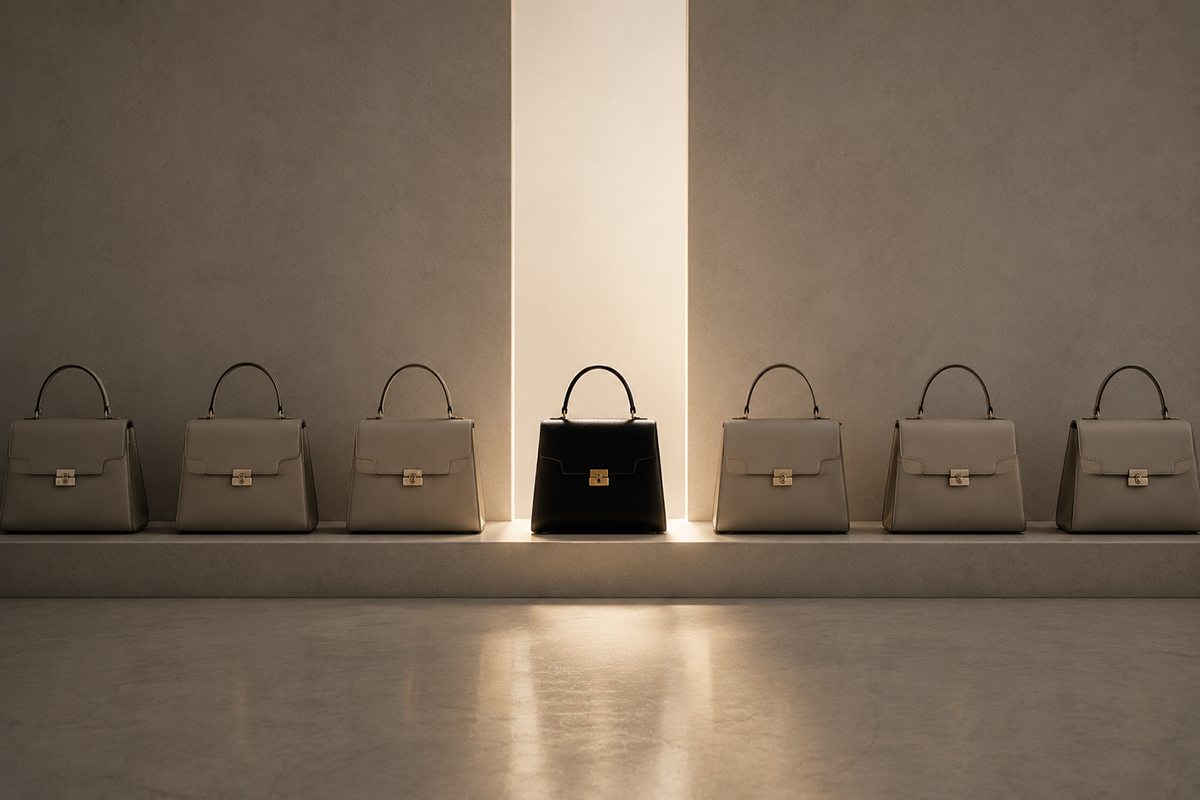
Iconic pieces are replicated across similar consumer profiles, creating a sense of déjà-vu across the market. The same silhouettes, the same “hero” products, the same visual codes circulate endlessly.
The consequence is not only aesthetic fatigue, but emotional fatigue.
Luxury, by definition, relies on desire. And desire weakens when everything starts to look the same.
WHEN BRANDING STRATEGIES CONVERGE IN THE LUXURY INDUSTRY
This homogenization is not limited to products.
Branding strategies, communication frameworks, and portfolio construction have also become increasingly aligned. Brands benchmark each other continuously, often adopting similar storytelling structures, similar campaign aesthetics, and similar positioning narratives.
In doing so, many houses become trapped in their own heritage: a powerful asset, but also a constraint when it prevents reinvention.
BREAKING THE LOOP, REINTRODUCING CREATIVE INTENT
The question is no longer whether luxury is growing or not. The real question is how it can escape this loop.
Luxury was never originally a scale-driven industry. It emerged from creative intention: from the vision of a creator, where profit was a consequence, not the starting point.
There is no denial that we live in an accelerated world, shaped by digital stimuli, global demand, and financial accountability. Luxury is, of course also a business and must remain sustainable.
But sustainability should not come at the expense of meaning.
Today, consumers are increasingly seeking refuge. They are looking for emotional stability in a fragmented world: beauty, intimacy, attention, and a sense of recognition.
They do not just want products. They want connection.
RETHINKING THE MODEL: FROM VOLUME TO VALUE
Reversing the cycle does not necessarily mean rejecting growth, but rethinking its logic.
Instead of continuous price increases as a short-term lever for exclusivity, brands could re-anchor desirability through controlled scarcity, sharper positioning, and stronger creative intent.
Less but better.
This also requires giving time back to creation: more considered and bold launches, more intentional collections, and stronger editorial direction behind each release. Luxury actors should reclaim a leading role in creation rather than following trends.
RE-CENTERING THE CUSTOMER EXPERIENCE
Another key shift lies in the consumer experience itself.
Luxury retail has, in many cases, lost its sense of intimacy. A more meaningful approach would reintroduce a true sense of personalization: guided discovery, private consultations, and a more curated relationship between client and brand, regardless of purchase level. This is key to building true customer loyalty.
Luxury should not feel transactional. It should feel considered.
TOWARDS STRONGER BRAND EQUITY
Rebalancing creativity and structure would ultimately reinforce what luxury brands are seeking most today: long-term brand equity as well as performance.
In a world of increasing uniformity, singularity becomes the most valuable luxury of all.
Marine Moureaux-Gall / MAENA Agency