Theme: Longevity skincare
The beauty industry is being asked a different question. Not how to erase the signs of time — but how to support the body’s capacity to age well, for longer. This is not a trend. It is a structural shift in how we understand the relationship between appearance, health, and time. And for brands willing to engage with it seriously, it represents one of the most meaningful repositioning opportunities of the decade.
FROM ANTI-AGING TO WELL-AGING: A CHANGE IN LANGUAGE, A CHANGE IN INTENT
The old vocabulary of beauty — correction, repair, erasure — is losing its hold. Consumers are growing wary of the promise that youth is something to be restored, and increasingly suspicious of procedures and products that claim to override biology entirely. What is replacing it is a more nuanced, and ultimately more ambitious, idea: that the goal of beauty is not to look younger, but to age well — with health, with clarity, with identity intact.
This shift is visible in language first. “Well-aging” and “skin longevity” are replacing “anti-aging” in product naming, brand communication, and clinical research. But the change runs deeper than vocabulary. It reflects a growing awareness that the aggressive, corrective model of beauty — the fillers, the resurfacing, the constant intervention — often produces results that distance people from themselves rather than reconnecting them. The uncanny valley of cosmetic overcorrection is becoming culturally visible, and consumers are starting to push it back.
The emerging aspiration is something more honest: to preserve one’s face, to remain true to oneself, to inhabit one’s body with ease and confidence for as long as possible. This is a profoundly different brief for beauty brands to answer.
THE EAST HAD IT RIGHT ALL ALONG
This reorientation is not happening in a vacuum. It is, in large part, a belated Western adoption of philosophies that have long been central to health traditions across Asia.
In Japan, the concept of ikigai — a sense of purpose and vitality found in daily rituals — has shaped a fundamentally different relationship with ageing. Japanese skincare philosophy prioritises prevention, gentleness, and long-term consistency over dramatic intervention. The goal is not transformation but maintenance: sustaining the skin’s own intelligence, protecting its barrier, supporting its natural cycles. Shiseido’s recently reformulated ULTIMUNE Power Infusing Serum, built on over 30 years of immunobiology research, exemplifies this logic — technology in service of the skin’s own defences, not in spite of them. It embodies the concept of “slow-aging”.
In Korea, the paradigm is equally instructive. Amorepacific, one of Asia’s most influential beauty groups, unveiled its ‘Holistic Longevity Solution’ vision at IMCAS World Congress 2026 — a comprehensive technology framework centred on two pillars: preventive care that shields the skin from environmental and lifestyle stressors before damage occurs, and active care that promotes the restoration of cellular function once decline has begun. Amorepacific’s star Time Response line is built on the brand’s proprietary green tea bio-science research and is designed to support skin regeneration and vitality at a cellular level. Rather than focusing solely on the correction of visible signs of ageing, it emphasizes long-term skin resilience and healthy ageing, aligning closely with the emerging well-ageing paradigm. Amorepacific is also co-developing with MIT a next-generation electronic skin platform — ‘Skinsight’ — that attaches to skin to measure multiple aging factors simultaneously using AI, enabling genuinely personalised longevity care.
What these Asian approaches share is a foundational belief that has taken the West far longer to articulate: that prevention is not passive. It requires knowledge, discipline, and commitment — and it begins far earlier than most corrective approaches. The shift from “curing” to “sustaining” is not a retreat from ambition. It is a redefinition of it.
AT THE CROSSROADS OF MEDICINE AND COSMETICS
What is distinctive about this moment in longevity beauty is the degree to which it is being shaped by genuine scientific rigour, and by a new dialogue between the medical and the cosmetic worlds.
At this year’s Makeup in Paris conference, a session titled “The Experience of Conscious Beauty” offered a striking illustration of where this convergence is heading. Two speakers, from entirely different disciplines, arrived at the same conclusion from different directions.
Dr Valérie Leduc, co-founder of Maison Epigenetic, approaches beauty through the lens of epigenetics — the science of how lifestyle and environment shape gene expression, independently of genetic inheritance. Her practice seeks first to understand the underlying causes of skin conditions and accelerated ageing: stress, sleep, nutrition, emotional state. The cosmetic intervention, in this model, is the last step, not the first. It is meaningful only insofar as the deeper imbalances have been addressed. This is medicine thinking through beauty.
Gaëlle Castex, Head of Training at Gemology Cosmetics, represents a complementary approach: skincare built around precious trace elements extracted from gemstones and minerals. Rooted in the brand’s concept of cutaneous oligotherapy, Gemology argues that modern lifestyles and nutrient depletion can compromise the skin’s biological balance, and that replenishing essential minerals through targeted skincare can help support the skin’s natural functions before visible signs of ageing appear. In this sense, the brand positions skincare as a preventive practice focused on long-term skin vitality rather than corrective intervention.
What makes this convergence significant is not merely the science. It is the posture. Both approaches treat the consumer as someone capable of understanding complexity, of making informed choices about their health, of building practices rather than purchasing promises. This is a fundamentally different relationship between brand and customer — one built on education, rather than seduction.
THE MARKET IS RESPONDING
The luxury beauty market has begun to formalise its commitment to longevity science in ways that signal this is no longer a niche positioning.
In June 2026, Clarins opened the Dr Olivier Courtin Clarins Longevity Research Center — a dedicated scientific institution built on 30 years of skin longevity research, ten patents, and 13 peer-reviewed publications. The centre brings together specialists in ageing biology, dermatology, epidemiology, behavioural science, and biomedical engineering. Its founding premise is epigenetic: that while roughly 15% of gene expression is fixed by inheritance, 85% can be shaped by lifestyle and environment. For Clarins, this is not a communication move. It is a long-term scientific commitment.
Lancôme launched Absolue Longevity MD in March 2026 at the American Academy of Dermatology Annual Meeting — a significant choice of venue. The five-product line, developed in partnership with Swiss longevity biotech firm Timeline, introduces Mitopure (Urolithin A) into topical skincare for the first time. Urolithin A works at the mitochondrial level, supporting cellular energy production and renewal — mechanisms that underpin skin vitality at a biological rather than cosmetic level. The line is structured around three clinical phases: Anticipate, Intercept, and Reset — a framework borrowed from preventive medicine, not from beauty marketing.
ALAENA Cosmetics has taken a further step with its Longevity Complex — a range designed to support the skin’s functional longevity by reactivating essential biological cycles. Its integration of targeted supplementation alongside topical care reflects a growing understanding that what the skin lacks is increasingly dietary: the western diet provides insufficient oligoelements, antioxidants, and cellular precursors to sustain skin health over time. ALAENA positions itself explicitly at the intersection of nutricosmetics and dermatological science.
L’Oréal, meanwhile, has developed a Longevity AI Cloud — presented at VivaTech 2026 — that analyses over 260 skin biomarkers to forecast the impact of specific ingredients before clinical testing begins. This is longevity science at industrial scale: the capacity to model biological ageing across populations, accelerate discovery, and personalise intervention in ways that were unimaginable a decade ago.
AN HOLISTIC APPROACH, IN THE FULLEST SENSE OF THE TERM
The word “holistic” has been overused in beauty for years. Here, it deserves to be reclaimed in its full meaning.
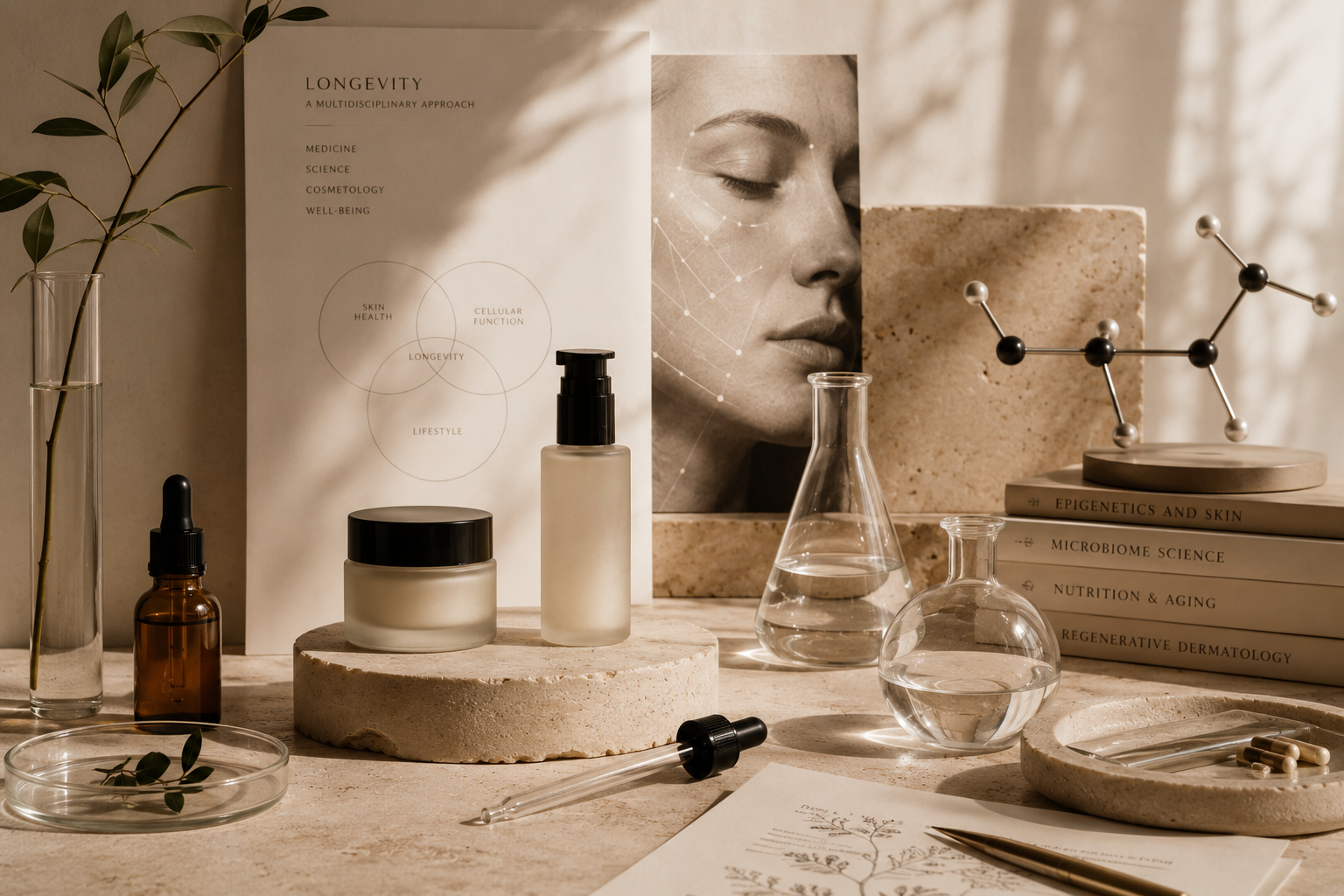
Skin longevity cannot be addressed by skincare alone. The most advanced research in this space consistently points to the same set of interdependent variables: nutrition, physical exercise, sleep quality, stress management, social connection, and purpose. These are not supplements to a skincare routine. They are the conditions that determine whether any skincare routine can function as intended.
This is the insight that connects Dr Leduc’s epigenetic practice, Japanese ikigai philosophy, Amorepacific’s holistic longevity framework, and Clarins’ multidisciplinary research centre. Each of them, from a different angle, is saying the same thing: that beauty professionals — whether cosmetic dermatologists, skincare brands, nutritionists, coaches, or aesthetic practitioners — have a genuine public health role to play.
That role is to be part of a broader ecosystem of care that helps people understand their bodies, build sustainable habits, and approach ageing as something to be supported rather than resisted. The beauty professional who can situate a skincare recommendation within a conversation about sleep, stress, and nutrition is offering something categorically different from the one who sells products alone.
This is not bullshit wellness. It is preventive intelligence — applied at the level of daily practice, through education and awareness.
WHAT THIS MEANS FOR BEAUTY BRANDS
The longevity shift is not an invitation for every brand to rebrand as a wellness company. It is, rather, a call for clarity about what a brand genuinely knows, stands for, and can offer with intellectual integrity.
The brands that will build lasting desirability in this space are those that can answer a specific question: what is your brand’s genuine contribution to how people age well? Not what ingredients you use, but what understanding you bring. Not what claims you make, but what practices you support. Not what the product does on the skin surface, but what it does in the context of a life being lived with intention.
This is demanding. It requires investment in science, in education, in partnerships with practitioners across disciplines. It requires restraint — the willingness to say less and mean more. And it requires a long view: the understanding that trust in this space is built over years of consistent, substantiated action, not campaign cycles.
For premium and independent beauty brands, this is not a threat. It is the clearest strategic opening in a generation. The brands that have built genuine expertise — in a specific ingredient, a regional botanical tradition, an approach to formulation, a skin condition — are precisely the brands that can speak with authority in the longevity conversation. They do not need to compete with Lancôme’s biotech investment or L’Oréal’s AI infrastructure. They need to articulate, with precision and conviction, what they know that no one else does.
This is beauty at its most serious — and its most necessary.
Marine Moureaux-Gall / MAENA Agency