
Theme: VivaTech 2026: Beauty & Technology
Last week in Paris, Europe’s largest technology event became, for four days, a laboratory for the future of beauty. The question worth asking is what it reveals.
THE SIGNAL BENEATH THE SHOWCASE
VivaTech is, by design, an event of announcements. Booths compete for spectacle. Innovations are packaged for press. And yet, underneath the product launches and the immersive installations, this year’s edition carried a more significant signal: the beauty industry is no longer using technology to sell better. It is using it to redefine what a beauty brand fundamentally is and to create meaningful value.
The beauty market has become a genuine innovation laboratory — a space to test, learn, and apply across a wide range of disciplines. For over a decade, we have seen brands and groups dedicate years of research toward a clear goal: contributing to progress, efficiency, and sustainability across every dimension of the brand experience. Those brands are now differentiating themselves from the market, and playing ahead of it.
L’Oréal, LVMH, Robertet — three organisations with entirely different business models and market positions — each arrived at VivaTech with a version of the same answer. Technology, in their hands, is not a communication tool. It is an identity tool. It is how they articulate what they know, what they stand for, and what they can offer that no one else can replicate.
That convergence is worth examining carefully. Because it suggests that the most forward-thinking beauty brands are not asking ‘how do we use AI?’ They are asking something harder: ‘what does this technology allow us to express about who we are?’ — and, beyond that, ‘where does it genuinely create added value for the people we serve?’ In a market where innovation has become the norm, the differentiating question is no longer whether to adopt technology, but what meaning it carries when you do.
FROM FORMULA TO ALGORITHM: R&D AS BRAND STATEMENT
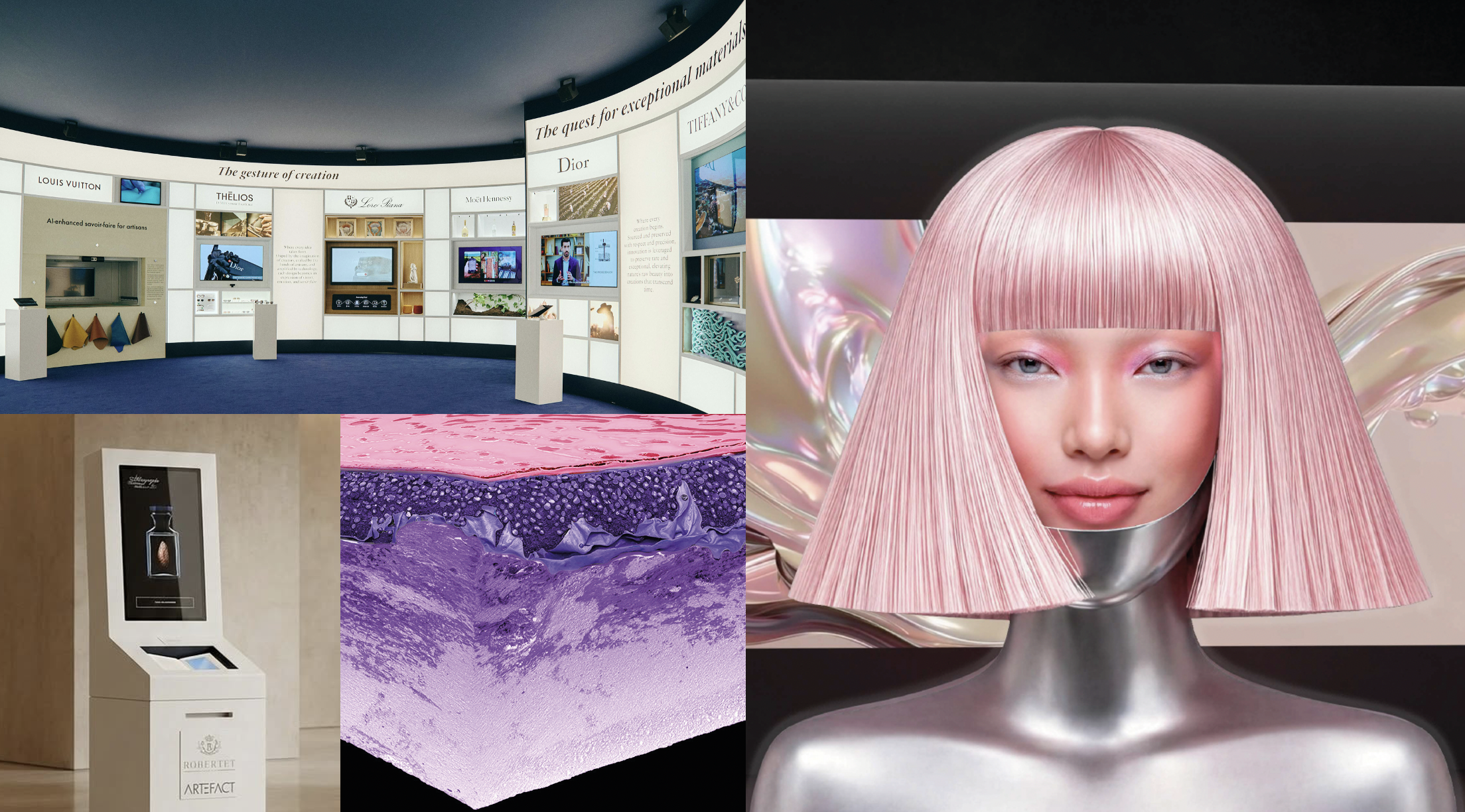
L’Oréal’s Beauty Odyssey — the name alone signals ambition — was organised around the premise that over a century of scientific leadership is now being amplified, not replaced, by artificial intelligence. The Hair Digital Twin, a 3D virtual fibre model trained on the world’s largest hair science database, screens molecules three times faster and predicts performance across all hair textures. The Longevity AI Cloud analyses over 260 skin biomarkers to forecast the impact of specific ingredients before a single physical test begins.
What these innovations communicate, beyond their technical specifications, is a particular brand conviction: that beauty is a science, and that L’Oréal owns that science more completely than anyone else. The technology is not incidental to the brand. It is the proof point of its identity.
This matters strategically because it anchors innovation in heritage rather than novelty. A brand that presents AI as a tool to produce content faster is making a claim about efficiency. A brand that presents AI as the vehicle through which 116 years of expertise becomes more precise and more personal is making a claim about irreplaceability. This is the difference between a campaign and a position.
THE SUPPLY CHAIN AS A STORY WORTH TELLING
LVMH’s DreamGallery — nearly 600 square metres organised as a journey through the group’s entire value chain — made an argument that most luxury brands still resist making explicit: that what happens before the product reaches the consumer is itself a source of meaning.
FairlyMade, winner of the Best Impact Award at the LVMH Innovation Awards, offers raw material traceability and environmental impact measurement across the supply chain. That a luxury group chose to give its highest sustainability prize to a traceability platform — rather than to a consumer-facing innovation — is a strategic signal. It suggests that LVMH understands something important: that the provenance of materials, the integrity of sourcing, the transparency of production processes are no longer compliance obligations. They are brand assets.
For premium beauty in particular, the origin story of an ingredient — where it was grown, how it was extracted, what it carries in terms of place and craft — is increasingly part of what consumers are buying. FairlyMade makes that story verifiable. In a market saturated with claims, it is the new form of credibility.
WHEN A PHOTOGRAPH BECOMES A PERFUME
Of everything shown at VivaTech this year, Le Scentographe by NaturIA — created by Robertet in collaboration with the AI firm Artefact — is the innovation that most directly addresses the question of meaning in beauty.
NaturIA analyses a photograph: its light, colours, textures, depth, emotional composition. It translates that visual signature into a unique fragrance. One hundred personalised scents were created for participants at the event. The installation was a demonstration of what becomes possible when 175 years of perfumery expertise — accumulated formulas, descriptors, olfactory intuitions — is structured as data and used to train an intelligence capable of translating one sense into another.
What makes this significant is the philosophy behind it. Robertet did not use AI to produce fragrance more cheaply or at greater scale. They used it to extend the reach of human creative expertise into territories that were previously inaccessible — turning a memory, an image, an emotion into something that can be worn. That is a profound expansion of what a fragrance house can offer. And it is only credible because the AI was trained on genuine craft knowledge, not on generic data.
The lesson for beauty brands is precise: technology creates meaning when it is rooted in real expertise. An AI fragrance generator with no heritage behind it is a novelty. NaturIA, trained on a century and a half of Robertet’s creative memory, is something else entirely.
THE BEAUTY ADVISOR IS NOW AN ALGORITHM
Perhaps the most structurally significant shift visible at VivaTech was the repositioning of the point of sale. Lancôme’s Cell BioPrint device estimates the skin’s biological age — distinct from chronological age — from a simple surface sample, then recommends a personalised longevity routine. Kérastase’s K-SCAN, already deployed across 9,000 salons, delivers AI-powered scalp diagnostics before any treatment begins. L’Oréal’s high-resolution imaging technology produces medical-grade 3D images of living skin, non-invasively, in real time.
The in-store beauty counter, in this model, begins with a diagnostic. The product recommendation follows the data. This reverses the traditional logic of beauty retail — where the product is the starting point and personalisation is, at best, an aspiration — and replaces it with something that resembles a consultation more than a transaction.
For brands, this shift has deep implications. A diagnostic experience anchors the product recommendation in objective evidence rather than subjective persuasion. It transforms the brand relationship from one of desire into one of trust. And trust, in beauty, is a far more durable foundation for loyalty than aspiration alone.
Beyond the in-store experience, L’Oréal’s collaboration with OpenAI — bringing Maybelline’s virtual try-on inside ChatGPT — and Sephora’s integration into both ChatGPT and Google Gemini signal something more fundamental: large language models are becoming the new front door to beauty discovery. The brands with the deepest, most structured knowledge layers will be the ones whose recommendations surface. The battle for relevance has moved upstream, into the architecture of AI.
WHAT CONNECTS ALL OF THIS
These innovations, diverse as they are, share a common logic. Each one uses technology not to replace what is essential about a beauty brand — its expertise, its heritage, its relationship with the consumer — but to make that essential quality more precise, more accessible, more provable.
L’Oréal uses AI to make 116 years of science more predictive. Robertet uses it to make 175 years of perfumery creativity more expansive. LVMH uses it to make the integrity of its supply chain more transparent. In each case, the technology serves the identity.
This is the critical distinction. Technology that serves brand identity creates meaning. Technology that leads brand identity creates noise. The difference is not in the sophistication of the tool. It is in the clarity of what the brand is trying to say — and whether the technology genuinely extends that, or merely illustrates it for the duration of a trade show. The brands that get this right create value across the full spectrum: from how ingredients are sourced and formulas developed, to how the product reaches and is experienced by the consumer. That coherence — sustained from production to client experience, at every stage — is what turns technology into lasting competitive advantage.
THE QUESTION PREMIUM BRANDS MUST NOW ASK
For independent or repositioning beauty brands, VivaTech 2026 raises a question that cannot be answered by watching the industry leaders and following their lead. The question is: what do we know, that no one else knows in quite the same way, and how does technology allow us to express that more completely?
A brand built around a particular approach to natural ingredients, a regional tradition of botanical knowledge, a founding vision for what skin health should mean — these are the raw materials for exactly the kind of technology integration that creates lasting value. Not because the technology is impressive, but because it is rooted in something irreplaceable.
The risk, for premium brands navigating this moment, is investing in technology before the underlying brand identity is sufficiently clear to give that technology direction. AI applied to a vague brand proposition produces vague results at scale. Applied to a precise, well-articulated identity, it becomes a multiplier of everything that makes the brand singular.
VivaTech 2026 was, among other things, a demonstration that the most valuable innovations in beauty are the ones most deeply connected to what a brand already is — the value it creates for its customers, and the responsibility it holds toward the world it operates in. That connection — between technology and identity, between innovation and meaning — is built upstream, in the strategic work that precedes every product, every partnership, and every platform decision.
The brands that will use this technological moment to build lasting desirability are those that will remain ahead of the market.
Marine Moureaux-Gall / MAENA Agency