The decline of modern luxury codes (3/3): Father’s Day and the Conformity of Commercial Moments
After exploring the uniformisation of luxury aesthetics and the visual fatigue caused by ambassador overexposure, this third chapter takes a different angle — not a trend, but a moment. A calendar moment that luxury brands can no longer afford to ignore, and yet, one that reveals everything about where they stand.
Father’s Day. A date circled in red on every commercial calendar — and this year, it falls on June 21st, now just ten days away. A moment that, by its very nature, forces brands to answer a fundamental question: are we here to sell, or are we here to create meaning?
In luxury fragrance — one of the most emotionally charged and codes-driven categories in the premium universe — this question has never been more pressing.
KEY COMMERCIAL MOMENTS: A STRUCTURAL TENSION FOR LUXURY BRANDS
In mass market retail, Key Commercial Moments (KCMs) are a playbook. Black Friday, Valentine’s Day, Mother’s Day, Father’s Day — each comes with its promotional mechanics, its gifting push, its urgency messaging. The system is efficient. It is also, by definition, standardised.
For luxury brands, KCMs represent a structural paradox: they cannot fully ignore them (gifting seasons drive a significant share of fragrance revenue), yet participating on the same terms as mass market inevitably erodes the very codes that justify premium positioning.
The question is not whether to show up. It is how — and with what level of creative conviction.
This Father’s Day, observing the fragrance landscape across niche, heritage, and luxury maisons reveals a clear and telling spectrum of responses.
A TAXONOMY OF LUXURY FRAGRANCE RESPONSES TO FATHER’S DAY 2026
1. THE ABSENT — DELIBERATE SILENCE AS BRAND STATEMENT
Brands like Frédéric Malle and Le Labo chose not to communicate around Father’s Day in any visible, commercial way. For houses built on radical editorial positioning and a near-institutional refusal of mainstream codes, this silence is coherent. It is a brand statement in itself.
Not every luxury brand can — or should — take this stance. But for those whose DNA is built on anti-commercial conviction, staying silent is more powerful than showing up poorly.
2. THE TRANSACTIONAL — COMMERCIAL INTEREST FOREGROUNDED
At the other end of the spectrum, certain brands led with pure commercial mechanics. Tom Ford’s approach — complimentary gifts on orders above $225 — is honest in its intent but reveals a tension: when a luxury house communicates primarily through threshold-based gifting incentives, it aligns itself, visually and semantically, with promotional retail. The brand equity absorbed by this type of communication is a cost that rarely appears on a marketing dashboard.
3. THE MINIMAL — GIFT EDITS WITHOUT NARRATIVE
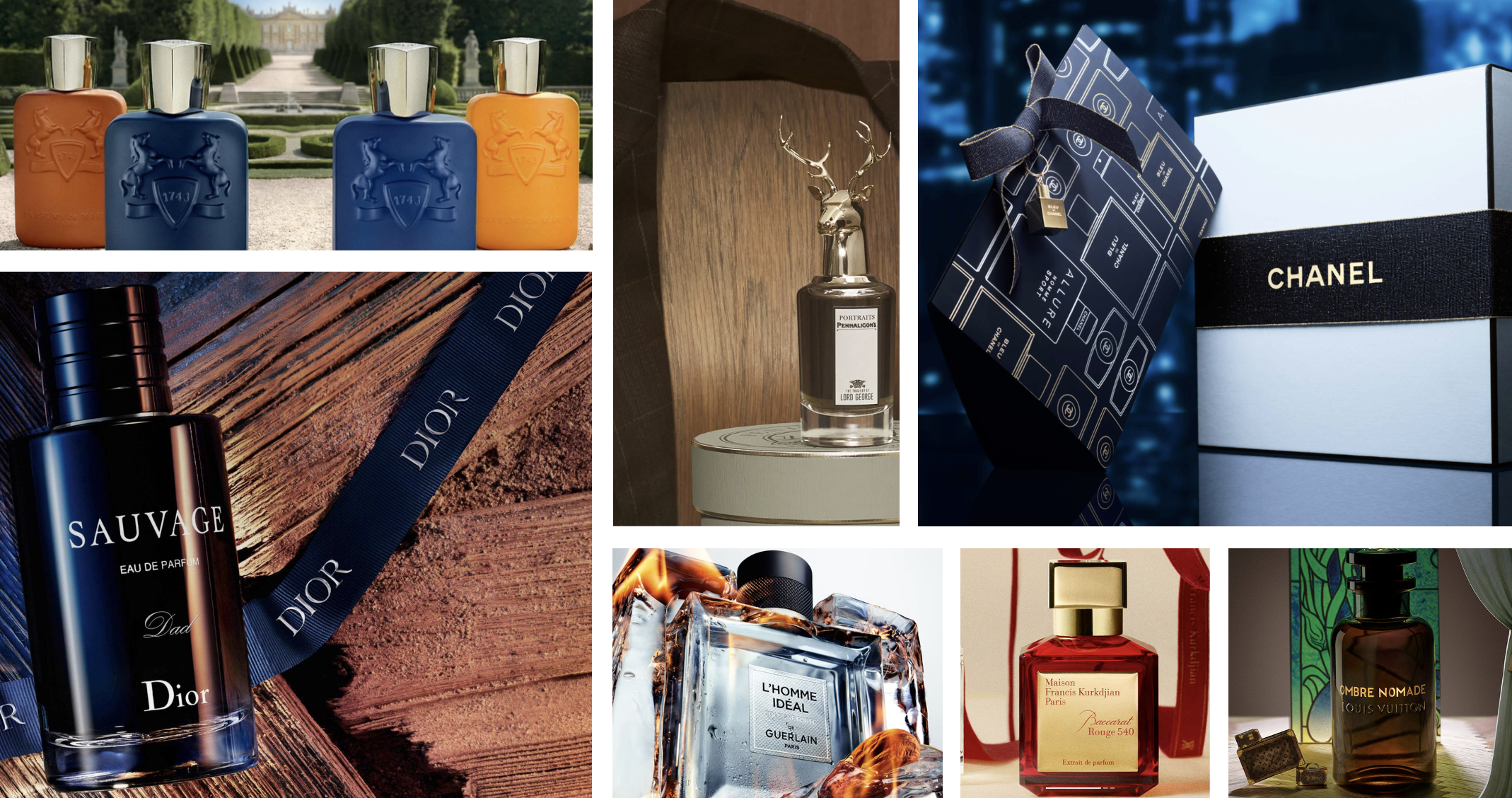
The largest group falls into a middle ground: a curated gift selection, a few digital visuals, a dedicated landing page. Penhaligon’s, Acqua di Parma, Maison Francis Kurkdjian, Creed, Guerlain, Amouage all activated Father’s Day with varying degrees of polish but limited creative ambition.
The execution is often clean, the products beautifully presented — but the storytelling is largely absent. What is communicated is the what, rarely the why. In luxury, the why is everything.
4. THE ENGAGED — BRAND SPIRIT MEETS THE MOMENT
A step above, brands like Louis Vuitton and Parfums de Marly demonstrated how a KCM can be reinterpreted through a distinct creative lens. Rather than simply presenting products for gifting, they built a world — playful, specific, rooted in house codes — where the commercial purpose exists but is elevated by a genuine narrative layer.
This approach is harder to execute and requires creative resources, but it is also the one that builds brand equity while driving conversion. A rare and valuable combination.
5. THE INVESTED — FULL CAMPAIGN ARCHITECTURE
Dior and Chanel deployed the most complete Father’s Day activations: dedicated landing pages, original campaign visuals, crafted art-of-gifting content, and a clear hero product strategy — Dior Homme and Sauvage for Dior, Bleu de Chanel for Chanel.
The level of production is undeniable. The creative investment, significant. And yet — a note worth making — both campaigns converge on a remarkably similar visual territory: deep blues, mysterious and intense atmospheres, a certain masculine gravitas that feels almost interchangeable. Two of the most powerful luxury houses in the world, communicating around the same moment, with the same chromatic codes, the same emotional register.
This visual convergence is not accidental — it reflects category conventions that have calcified over years. But in a series dedicated to the decline of distinctiveness in luxury, it is impossible not to flag it.
THE CONVICTION: COMMERCIAL MOMENTS ARE NOT THE ENEMY — CONFORMITY IS
There is no universally right or wrong way for a luxury fragrance brand to approach Father’s Day. A house’s decision to communicate — or not — should flow naturally from its positioning, its creative direction, and its relationship with its audience.
But the observation stands: when a luxury brand decides to activate a Key Commercial Moment widely, the standard must shift. Not just polished visuals. Not just a curated edit. But a genuine invitation — into a world, a ritual, an emotion that is uniquely theirs.
The risk is not commercialisation itself. Gift-giving is a profoundly human gesture, and luxury has always known how to elevate it. The risk is uniformity — the slow convergence toward the same mechanics, the same formats, the same colors, that turns singular maisons into interchangeable SKUs in a gifting dropdown.
Exclusive services, unexpected storytelling angles, editorial boldness, emotional depth — these are not incompatible with commercial ambition. They are, in fact, the only sustainable basis for it in the luxury space.
The brands that will endure are not those that show up the loudest at every commercial moment. They are those that, when they do show up, make you feel something no one else could have made you feel.
AN OPENING QUESTION
As Father’s Day approaches, I find myself returning to the same question I asked myself throughout my years working inside luxury houses. The campaigns are live. The gift edits are up. The season is wide open.
If you removed the logo from this campaign — would you still know whose it was?
In fragrance more than anywhere else, where the product itself is invisible and the brand is everything, that question is not rhetorical. It is the only brief that matters.
What do you think? Are Key Commercial Moments compatible with true luxury distinctiveness — or does showing up always come at a cost?
Marine Moureaux-Gall / MAENA Agency