Theme: The decline of modern luxury codes (2/3): The Saturation of Faces
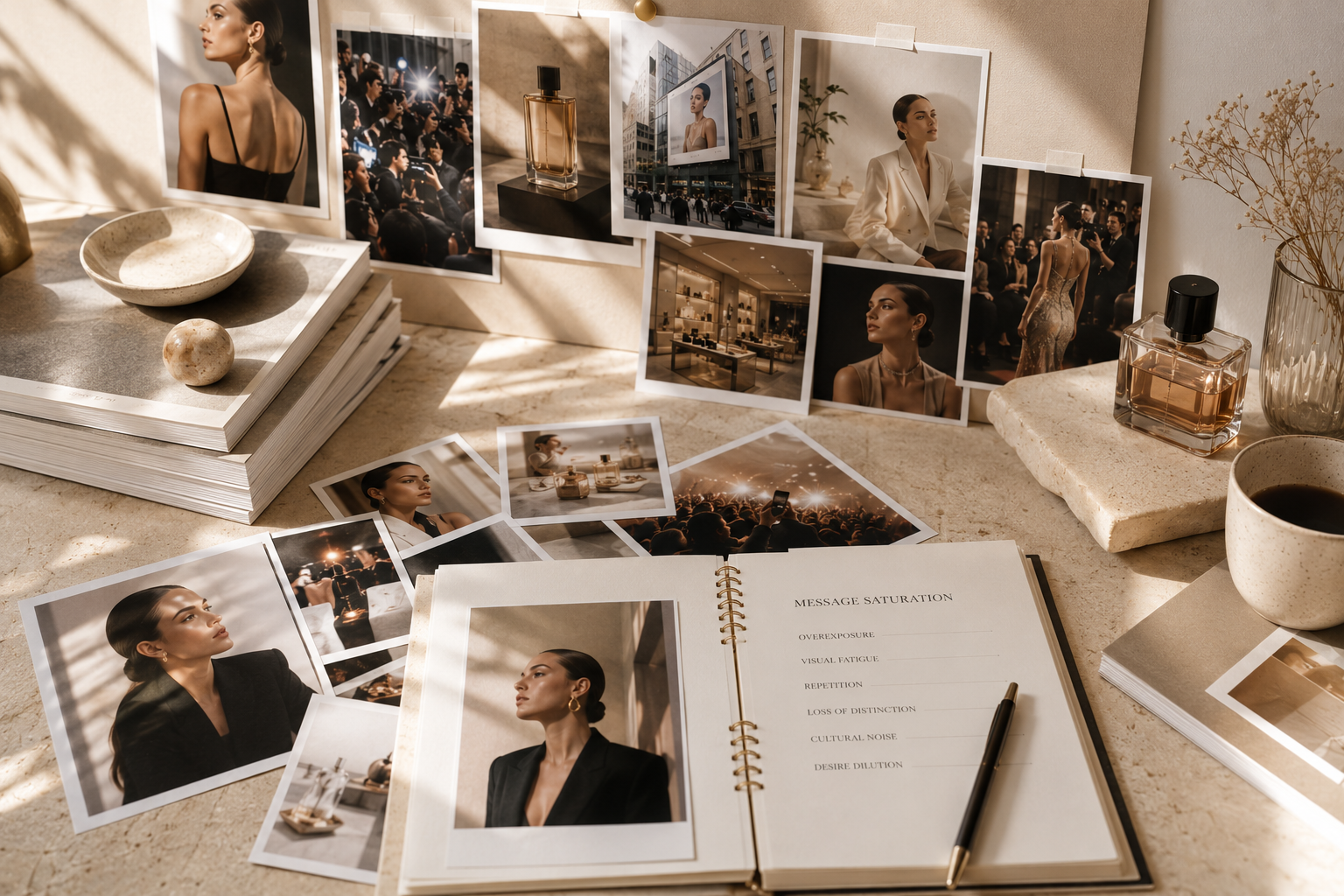
An exploration of how the overexposure of brand ambassadors is diluting luxury’s emotional impact — and quietly eroding the desire it was meant to build.
Luxury has always known how to choose its faces. The logic of the luxury brand ambassador strategy was once built on singularity: one house, one icon, one era. The right muse, the right moment, the right aura.
An ambassador was a rare choice — an artist or icon whose singular presence extended a brand’s universe without diluting it.
That model no longer exists.
As explored in the first article of this series on the standardisation of luxury codes, the loss of singularity begins well before the choice of a face.
WHEN FACES MIGRATE BETWEEN COMPETING HOUSES
The ambassador relationship was once built on exclusivity — a long-term alignment between a brand’s identity and a public figure’s image. Today, that alignment has become transactional and short-lived.
Faces rotate. Marion Cotillard, long the emblematic face of Dior’s femininity, became an ambassador for Chanel. Faces that once embodied a house’s identity are now available to the next campaign brief — or the highest bidder.
The implications go beyond aesthetics. When a consumer has associated a face with a brand, and then sees that same face representing a direct competitor, the emotional contract is broken. Loyalty, by definition, is not interchangeable.
Consumers are not naive. They notice. And what they register — consciously or not — is that the brand’s choice of face was never about genuine alignment. It was a media placement.
The result is not only confusion. It is disenchantment.
THE UBIQUITY TRAP — WHEN LUXURY BRAND OVEREXPOSURE KILLS DESIRE
Beyond brand-switching, there is a second, more structural problem: the concentration of luxury brand ambassador strategy around a very small set of highly visible figures.
Take Zendaya. At once the face of Louis Vuitton, On Running, Lancôme and Valentino — while simultaneously dominating cinema screens, appearing at every major cultural event, and anchoring every best-dressed list from Paris to New York. Her talent and cultural relevance are unquestionable.
But what happens when one face becomes omnipresent across luxury, fashion, cinema, and sport simultaneously?
Desire requires distance. Luxury, above all, relies on a certain inaccessibility — not in the crude sense of unattainability, but in the deeper sense of mystery, of rarity, of something that cannot be fully grasped. When a face is everywhere, it belongs to everyone. And what belongs to everyone cannot, by definition, signal exclusivity.
The same logic applies to the culture of mega-events. The same figures appear at the Met Gala, at fashion weeks, at film festivals, at music ceremonies. Fans are delighted. But for luxury brands, this visibility comes at a cost: the codes of rarity and singularity that justify premium positioning are systematically undermined.
Desire is not built through saturation. It is built through curation.
WHEN ENTERTAINMENT BECOMES A SHOWCASE
The overexposure of luxury does not stop at ambassadors. It has extended into a territory that was once far more discreet: entertainment.
Product placement has always existed. But what we are witnessing today is a structural shift: luxury brands are now omnipresent in major productions — Netflix series, blockbuster films, streaming content — to a degree that goes far beyond subtle integration. Bags, cars, jewels, and interiors are choreographed into scenes with the precision of a campaign shoot.
The result is a new kind of visual noise. Consumers are exposed to luxury products not in a context of desire and aspiration, but in the flux of entertainment consumption — binge-watched, fast-forwarded, half-attentive. The brand appears, but the emotion it needs to generate is absent.
Worse, when every major house pursues the same strategy simultaneously, the effect cancels itself out. Luxury is everywhere on screen. And precisely because it is everywhere, it signals nothing.
Integration into culture is legitimate. But culture must elevate the brand — not simply consume it as a prop.
WHEN POP CULTURE BECOMES THE MEASURE OF LUXURY
There is a further dimension to this shift that is rarely addressed directly: the nature of the figures luxury brands are now choosing to represent them.
Rihanna. Dua Lipa. Cardi B. These are cultural forces of extraordinary magnitude — artists who have redefined global pop culture and built iconic personal brands. Their cultural capital is not in question.
But the question luxury must ask itself is not “who has the most followers?” It is: does this figure embody what we stand for?
Luxury was originally built on codes of quiet elegance, restraint, craftsmanship, and a particular vision of beauty that existed independently of commercial popularity. It derived its authority from distance — from the impression that it operated in a register above the noise of mass culture.
Systematically anchoring luxury brand identity in the world of mainstream pop culture does not elevate pop culture. It lowers the register of luxury.
This does not mean luxury should ignore culture. Culture is where meaning is made. But there is a fundamental difference between being culturally relevant and being culturally indistinguishable from a mass entertainment brand.
Luxury must distinguish between cultural influence and cultural submersion.
THE MANUFACTURED FACE — WHEN LUXURY LOSES ITS ALLURE
There is a subtler form of uniformization at work — one that goes beyond strategy and touches luxury brand identity itself.
Luxury fashion has gravitated, systematically, towards a very particular type of face and body: the Bella Hadid archetype. Tall, geometric, surgically refined, technically perfect. These are not critiques of individuals — they are observations about a collective aesthetic decision made by an entire industry.
In choosing these faces as its primary visual language, luxury implicitly endorses a standard of beauty that is constructed, uniform, and increasingly indistinguishable across houses. The same cheekbones. The same jawlines. The same hollow gaze. The aspiration is legible — but it is the aspiration of a formula, not of a singular vision.
What luxury once offered was something rarer: allure. Allure is not perfection. It is the quality of a presence that cannot be entirely explained — an essence, a way of inhabiting a space, a singularity that cannot be replicated. Romy Schneider. Inès de la Fressange. Tilda Swinton. These faces were not interchangeable. They were irreducible.
By systematically favouring constructed perfection over authentic singularity, luxury is quietly eroding one of its most powerful codes: the idea that beauty, at its highest expression, is unrepeatable.
RETHINKING THE LUXURY BRAND AMBASSADOR STRATEGY — FROM VISIBILITY TO ALIGNMENT
The solution is not to abandon ambassadors. It is to rethink the entire strategic logic behind the choice.
The most powerful ambassador relationships in luxury history were long-term, coherent, and genuinely exclusive — built on shared values and sustained over time. Catherine Deneuve and Chanel. Audrey Hepburn and Givenchy. Grace Kelly and Hermès. These were not media placements. They were identity decisions.
Today’s model has inverted that logic. Speed, visibility, and cultural reach have replaced depth, alignment, and duration.
A more meaningful model already exists — and some houses still practice it. The concept of the “ami de la maison”: a figure who does not merely carry the brand’s image for a season, but genuinely belongs to its world, embodies its values, and grows with it over time. Chanel, more than most, has preserved this logic. It creates loyalty — not only with the public, but within the brand’s own ecosystem.
This approach requires three shifts.
First, genuine exclusivity — not contractual clauses, but strategic choices. A luxury house should not share its face with a direct competitor, now or in the future. The relationship must be singular on both sides.
Second, duration. Cultural alignment takes time to build. A one-season campaign cannot create the kind of emotional association that turns a consumer into a genuine believer. Loyalty is not manufactured through exposure — it is built through consistency and trust.
Third, cultural depth. The richest ambassador relationships are those rooted not in entertainment reach, but in genuine affinity with the brand’s creative universe — with the arts, literature, cinema, music, craftsmanship, and ideas that give the house its meaning. Culture as substance, not as backdrop.
The goal is not simply visibility. It is the construction of a universe — one that consumers wish to belong to, not merely observe.
Luxury does not win by being everywhere. It wins by being unmistakably itself.
In a world of increasing uniformity, singularity becomes the most valuable luxury of all.
Marine Moureaux-Gall / MAENA Agency