Summer has a way of making small formats suddenly indispensable. A skincare routine that feels perfectly reasonable at home becomes excessive once it has to fit into a cabin bag. A favourite blush needs to survive the journey from beach to dinner. Fragrance becomes something to carry rather than leave on a dressing table.
Beauty has answered with an abundance of miniatures. The format is also showing real commercial momentum: in US prestige fragrance, Circana reported that mini and travel-size juices grew 12% in units during the first nine months of 2025, while mini and discovery fragrance sets rose 41%.
Yet luxury still seems uncertain about what, strategically, a miniature is supposed to be.
Is it an accessible introduction to a house? A practical travel solution? An impulse purchase? A loyalty reward? Or an object desirable enough to stand on its own?
The answer matters because each role implies a different product, retail and economic model. If the mini becomes the cheaper substitute for the full-size product, brands risk training clients to remain at the lowest commitment level. If it is treated as secondary packaging for holidays, an opportunity to build equity is lost.
The more interesting direction is to make the format smaller without making the brand experience smaller.
SMALL FORMATS ARE BECOMING A CATEGORY OF THEIR OWN
The appeal of a miniature is easy to understand. It reduces commitment, makes experimentation easier and fits a more mobile beauty routine. It also allows consumers to build a repertoire: several fragrances, colours or rituals for different moments rather than one definitive choice.
Circana’s US prestige figures through September 2025 showed mini and travel-size fragrance juices up 12% in units and mini/discovery sets up 41%, even as high-concentration eaux de parfum and parfums remained important growth drivers. The category can therefore expand at both ends: high-value concentration and lower-commitment discovery are not mutually exclusive.
For brands, however, the economics are less straightforward. A miniature still requires its own componentry, filling, logistics, merchandising and inventory. More importantly, a successful mini can become strategically weak if it never leads anywhere else.
That makes conversion central. For a recruitment format, part of the value lies in what happens afterwards. Does the client return for the full bottle or jar? Does she enter another category? Does the purchase create a reason for a consultation, a personalised recommendation or a follow-up?
The mini becomes far more interesting when brands design the journey around it rather than judge it as an isolated SKU.
WHEN THE MINIATURE CARRIES THE FULL HOUSE
Bottega Veneta offers one of the clearest recent examples.
Alta, the house’s new ten-fragrance collection, extends the Intrecciato idea into scent by pairing an Italian ingredient with one sourced elsewhere. Its Miniature Set translates the same thinking into ten 10ml glass bottles, each with an all-over woven pattern inspired by the house’s signature craft.
We touched on this in MAENA’s Summer 2026 analysis because the detail already suggested something unusual: the travel format had not been treated as the simplified version of the object. The house code remained visible even when the scale changed.
Bottega has now pushed the idea further with a new Intrecciato piccolo calfskin perfume-holder charm designed specifically for the 10ml Alta bottle. The holder attaches to a bag handle through a leather lanyard. On the European site consulted for this article, the charm is priced at EUR 350, while the ten-fragrance Miniature Set is EUR 320.
The inversion is telling. The small fragrance is no longer merely the lower-value version of a full bottle. It becomes the reason another luxury object can exist.
Beauty starts behaving like fashion: the portable format can be accessorised, displayed and collected. Its smallness becomes part of its desirability rather than evidence of compromise.
For houses with recognisable codes, scale itself can become a creative medium. The miniature can carry materiality, gesture and identity in a way that feels intentionally small, rather than simply reduced.
BEYOND FRAGRANCE: A SMALLER ROUTINE, NOT A SMALLER EXPERIENCE
The same opportunity is appearing in skincare.
La Prairie’s new Skin Caviar Lifting Discovery Set gathers four of the house’s icons in miniature – Essence-in-Lotion 10ml, Luxe Eye Cream 3ml, Liquid Lift 5ml and Luxe Cream 5ml – in a travel pouch. The house explicitly positions the set as an introduction to its signature formulas. The mini therefore has a defined role: a compressed version of a recognisable ritual.
Dr Barbara Sturm’s Summer Kit 2026 approaches portability differently. It curates a four-step seasonal routine around Face Mask, Face Cream Light, Sun Drops SPF50 and Hyaluronic Face Mist, housed in a yellow terry bag and accompanied by a limited-edition hand fan. The use case comes first: summer skin, travel and continuity of care.
That distinction is useful. Consumers do not necessarily want a small jar because small jars are charming. They want their beauty behaviour to remain possible when the context changes.
The best mini strategy therefore begins with the moment of use. A weekend away, an evening bag, a long-haul flight, a summer routine or the desire to test a high-investment formula can each justify a different format.
For luxury houses, the design question is precise: which elements of the full experience are essential to preserve, and which can legitimately change with scale? The answer should come from identity and usage, not from a blanket decision to reproduce every bestseller in a smaller component.
RETAIL SHOULD GIVE THE MINI MORE AMBITION
Retail is where this opportunity remains underdeveloped.
The familiar mini environment is efficient: small products grouped near checkout, inside travel sections or among full-size assortments. It encourages impulse and makes discovery easy. But it also frames the category around convenience, price and last-minute add-ons.
Even Sephora is reconsidering that architecture. In its ongoing North American store redesign, the retailer has made its mini fixtures more modular as mobile checkout grows, allowing the setup to move away from the traditional queue and into other parts of the store.
That operational decision opens a more interesting strategic possibility: minis could deserve a retail territory of their own.
Not a crowded wall of reduced products, but a curated discovery space organised around occasions – the summer vanity, the long weekend, the evening bag, the flight, the ski trip, the fragrance wardrobe. Skincare, makeup, hair and scent could be merchandised together when the consumer need connects them.
For luxury retailers and beauty halls, that would elevate the mini from a checkout trigger to an editorial experience. The advisor could begin with where the client is going, what she wants to carry or what she is curious to try, rather than simply pointing to the smaller size.
Done well, the space could also support the commercial objective that matters most: what happens next. A discovery purchase can lead naturally to a consultation, a full-size recommendation, a follow-up message or a benefit redeemable against the larger product.
The impulse remains. The experience becomes more considered.
GATEWAY OR PRIVILEGE: TWO DIFFERENT BUSINESS MODELS
Not every mini needs to recruit a new client.
The first coherent model is the gateway. The client can discover a formula, colour or house with less commitment. In that model, conversion needs to be designed from the start. A discovery set might unlock a benefit against a full-size purchase; a skincare edit might connect to a consultation; a first mini purchase could trigger a more personalised follow-up than a standard replenishment email.
The point is not to force the client upwards. It is to ensure the miniature has a coherent place in the relationship rather than becoming a permanent substitute for the core offer.
The second model is almost the opposite: the mini as privilege.
Chantecaille is using that logic this August with a limited-time gift reserved for clients spending $300 or more in the US and Canada: four travel-ready skincare minis presented in a woven pouch. The miniature is not the cheaper door into the brand. It is an additional object available because the client has already demonstrated value to the house.
La Prairie is taking a similar approach in the US. Its current online offer gives a travel-size Micellar Water above $750, while orders above $1,200 receive an exclusive double pouch with three travel-size Skin Caviar miniatures.
This model deserves more attention. A mini can be desirable precisely because it is not freely available. Limited colours, collectible cases, personalised sets or travel objects reserved for loyalty tiers can reinforce belonging rather than accessibility. They need not even be cheaper.
The strategic choice is simple to state, even if execution is harder. A gateway must create the conditions for conversion. A privilege must deepen the relationship.
SMALLER DOES NOT AUTOMATICALLY MEAN MORE RESPONSIBLE
There is one contradiction luxury cannot ignore.
A small quantity of formula does not automatically create a small environmental footprint. The Ellen MacArthur Foundation has identified small-format cosmetic packaging among the formats that remain difficult to recycle; in its Global Commitment cosmetics analysis, 62% of signatories’ plastic packaging was still non-recyclable in 2022. European packaging regulation is also moving toward a system in which all packaging placed on the EU market must be recyclable in an economically viable way by 2030.
This is why the answer cannot simply be more minis.
The more constructive direction is to design portability around continued use. Durable outer cases, replaceable inner formats, refillable compacts, reusable pouches and components worth keeping can shift the model away from disposable novelty.
Bottega’s leather perfume holder is interesting in this respect without being, by itself, an environmental solution. It changes the status of the 10ml bottle by placing it within a durable accessory system. Luxury beauty can go further by making replenishment and reuse part of the object from the beginning.
Luxury has a particular strength here: it knows how to create attachment. If a client wants to keep, refill and carry an object because it is beautiful, well made and specific to the house, the responsible behaviour does not need to feel like a compromise.
That also argues for restraint. The objective should not be to miniaturise every hero product. It should be to identify the moments where smaller genuinely creates additional value, then make those formats sufficiently considered to deserve their place.
THE SMALLEST FORMAT CAN CARRY A LARGE STRATEGY
Summer makes the utility of minis unusually visible, but their relevance extends far beyond holidays.
They sit at the intersection of discovery, loyalty, retail experience, product design and commercial strategy. Used well, they can lower the psychological barrier to a first encounter, preserve a routine on the move, encourage experimentation across a portfolio or give an established client something more exclusive than the standard offer.
The next step for luxury beauty is to stop treating them as reduced versions of something more important.
A miniature deserves its own creative brief, its own merchandising logic and a defined role within the customer journey.
Sometimes that role will be to invite someone in. Then the brand must create the conditions for that first encounter to become a deeper relationship. Sometimes it will be the opposite: an object for those already close to the house, deliberately scarce, collectible and perhaps not particularly accessible at all.
Both can create value. The weak territory lies between them: small products that are easy to buy but difficult to connect to a broader brand strategy.
Bottega Veneta’s latest experiment points to what becomes possible when scale itself is treated creatively. The miniature fragrance is no longer simply the practical bottle for a suitcase. It has become something the client can dress in Intrecciato leather and attach to a bag.
The strongest mini should not make the house feel smaller. It should make the house easier to carry with you.
Marine Moureaux-Gall / MAENA Agency
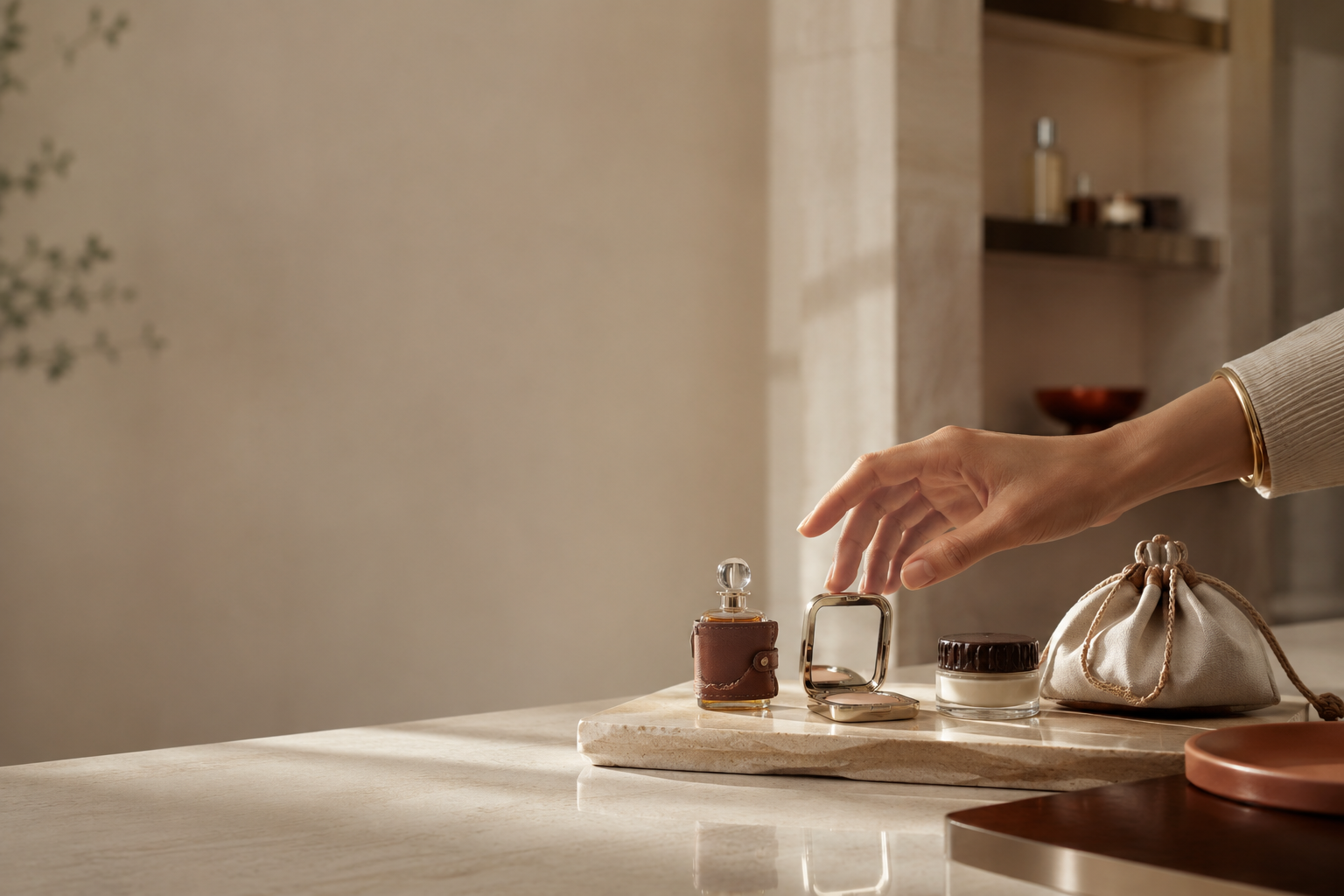
Featured image credit: AI-generated editorial visual, art-directed by MAENA Agency.