At MakeUp in Paris last month, one conversation stayed with me. The conference, led by Natacha Bensimon, founder of Blossom ID, with Gen Z beauty creators so_loic and Eljix, asked a deceptively simple question: who is makeup for now?
The official premise was revealing: from Gen Alpha discovering cosmetics through colour and play to adults questioning established standards of perfection, the session asked how self-expression is beginning to replace the idea of a single beauty standard.
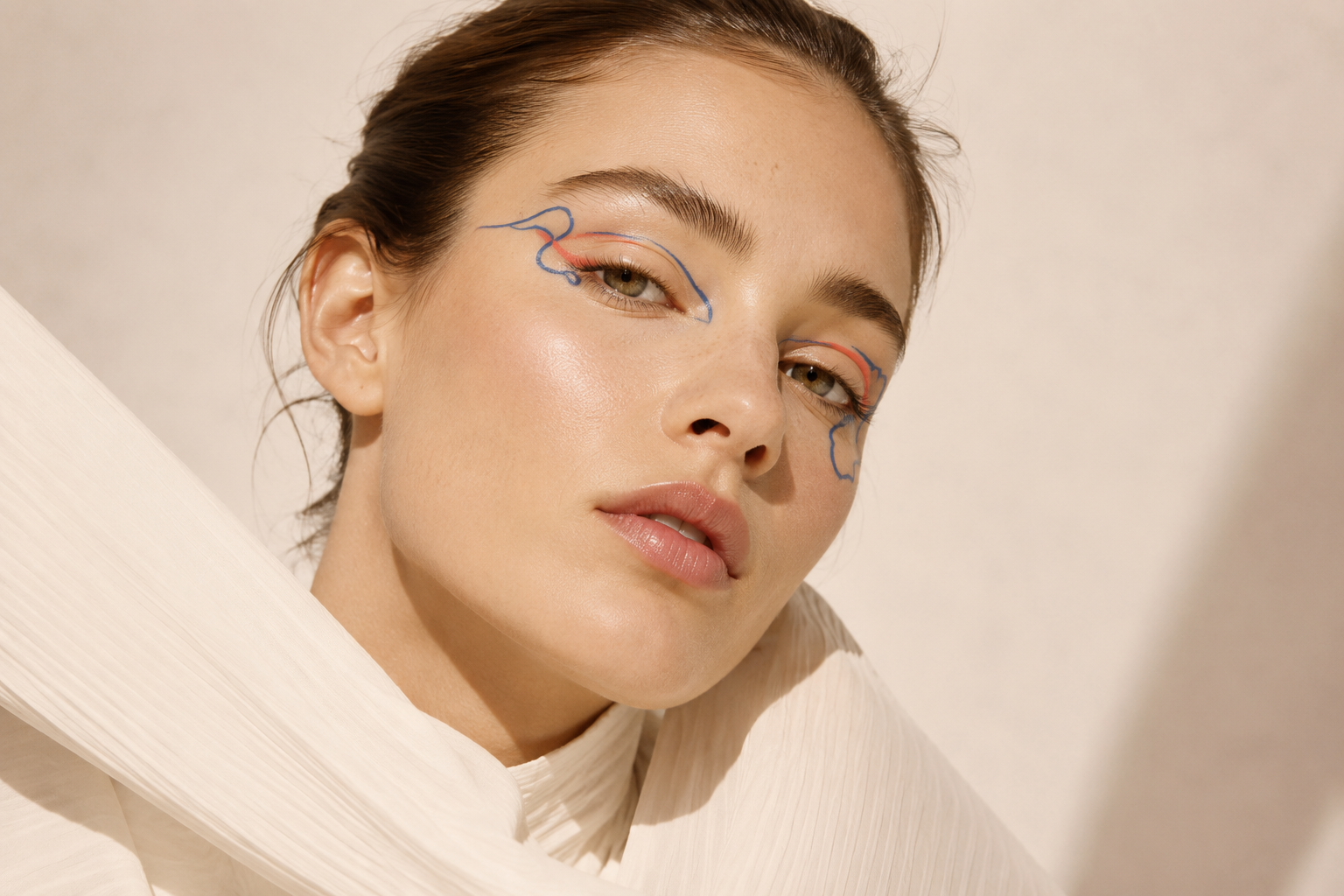
What interested me most was something subtler: the makeup gesture itself seems to be becoming freer. The line is no longer necessarily fixed or perfectly mastered; it can move, break and animate the face.
This does not mean the streets have suddenly filled with blue eyeshadow, graphic liner and glitter. The polished skin, neutral tones and apparent effortlessness associated with the clean-girl aesthetic remain highly visible. Nor should every colourful runway look be treated as proof of a mass consumer shift.
Yet the indications are becoming harder to dismiss. Blush is becoming more visible; eyeliner is moving beyond the perfectly controlled flick; eyeshadow is returning as a colour statement. Multichrome and metallic finishes have built strong communities around independent brands. Beyond beauty, colour is also becoming more visible in fashion, jewellery and luxury communication.
What may be changing is therefore larger than a palette. After several years dominated by highly controlled, optimised aesthetics, consumers appear increasingly willing to make themselves visible again.
CLEAN GIRL IS NOT OVER. ITS MONOPOLY MAY BE.
The clean-girl aesthetic became powerful partly because it suited the culture that produced it. Glowing skin, brushed brows, slick hair and neutral makeup translated particularly well across social media: apparently effortless, but highly codified and easy to reproduce.
It would be premature to declare that aesthetic finished. Natural-looking skin, restrained application and hybrid skincare-makeup products remain central to the market. What is interesting is the coexistence of something else.
Circana’s Beauty Book 2026 identifies self-expression as one of the forces reshaping beauty demand. Its May analysis offers a more concrete data point: in the US, purple eyeliner dollar sales rose 19% in the first quarter of 2026, versus 5% for the eyeliner category overall, while units rose 15%. Circana reads the broader colour movement as part of a shift towards individuality.
The commercial picture remains mixed, which is why this should be treated as an emerging cultural movement rather than a universal reversal. Circana also reported that makeup was the softest-performing US beauty category in the first quarter, although lip, blush and bronzer showed pockets of strength. Runway beauty offers a parallel indication: Spring 2026 brought coral washes, stronger lips and blurred colour alongside familiar natural looks.
The shift, then, is not from minimalism to maximalism. It is from one dominant aesthetic towards greater permission to choose. And that distinction matters for luxury.
WHEN THE FACE BECOMES A CREATIVE SURFACE
For several years, much of mainstream beauty has been organised around optimisation. Products lift, sculpt, blur and perfect; tutorials teach precision; algorithms expose millions of people to the same techniques. Faces are increasingly read through a shared language of glow and correction.
Colour introduces another possibility. A strong blush need not mimic a naturally flushed cheek. Eyeliner can sit somewhere unexpected. Eyeshadow can become a wash rather than a correction. Metallic pigment can catch the light for a few hours and disappear at the end of the day.
In that context, makeup becomes closer to an ephemeral creative gesture. This is the thought I took away from the MakeUp in Paris conversation. The line can move. It can be exaggerated, interrupted or imperfect. It can belong to the person wearing it rather than to a prescribed method of application.
Independent brand Kaleidos expresses this clearly. Its stated philosophy positions makeup as a vehicle for free and creative self-expression rather than for ‘fixing’ oneself or conforming to a beauty standard; its multichromes and unconventional finishes give material form to that position.
The relevance of such brands is not that every luxury house should imitate their aesthetic. It is that they reveal a different relationship between product and consumer: the product provides the material; the wearer retains authorship.
After years of filters, templates and increasingly generated imagery, there is something culturally compelling in that freedom. A human gesture can be irregular; a combination can be personal. Perhaps the emerging desire is not for more makeup, but for more authorship.
A YOUNGER GENERATION IS CHANGING WHAT MAKEUP IS FOR
This becomes particularly significant with younger beauty consumers. The presence of so_loic and Eljix mattered because the conversation was not coming only from forecasters interpreting Gen Z from a distance. Beauty creators themselves are shaping a language in which experimentation and identity can carry as much weight as conventional enhancement.
Gen Alpha may push this further, although brands need to approach the subject carefully. An Ulta Beauty study conducted by NielsenIQ among 522 US Gen Alpha consumers and 500 parents and guardians found a striking mix of digital discovery and physical experimentation: 78% discover beauty through at least one online source, yet 70% of makeup users prefer to shop in-store. Parents remain closely involved, with 98% saying they play an active role in purchases.
This complicates the assumption that the next beauty generation exists entirely through online virality. They may discover a look digitally, but the desire to touch, test and play remains important. And because many are still children, the opportunity comes with responsibilities around age-appropriate products, communication and guidance.
For established houses, cultural relevance cannot simply consist of adopting whichever colour or finish is circulating fastest. Younger generations need to recognise that a brand understands the way they use beauty. That is different from a heritage house attempting to behave like a teenage brand.
COLOUR CAN RENEW AN ICON WITHOUT REPLACING IT
This article continues something I noticed earlier this summer. Across Summer 2026 luxury campaigns, glow, Mediterranean light and restrained palettes dominated. Yet colour was beginning to appear at the edges: Cartier introduced coloured stones into the codified LOVE universe; Memo Paris built the saturated Villa Soleil expression; younger beauty cultures were moving towards bolder makeup. That earlier MAENA article asked whether luxury houses would follow, resist or reinterpret the movement.
The answer is already more nuanced than simply ‘use brighter colours’. Marc Jacobs Beauty offers a useful example. Coty relaunched the line in May around ‘Joyride Sensoriality’: tactile finishes and formulas designed to be layered, blended and played with. The brand frames the relaunch around colour, creativity, experimentation and play.
Colour is part of the proposition, but so are touch, humour and permission. That distinction is important. Colour can create immediate emotional impact, but luxury does not build lasting desirability by adding orange, purple or cobalt because those shades happen to be trending.
A house has to decide what colour can express within its own language. For Cartier, gemstones add another register to an established icon. For a beauty house, an archival shade, artistic association or historic pigment could provide the same legitimacy. For another brand, restraint may remain more distinctive than maximalism.
Colour becomes strategically powerful when it releases something already present in the house rather than disguising the house in the visual codes of another generation.
HERITAGE MAY NEED TO BECOME MORE PERMISSIVE
This raises a broader question for traditional luxury beauty brands. Heritage has often been transmitted through prescription: this is the house red; this is the silhouette; this is how the eye should be defined; this is the woman the campaign represents.
That authority can be part of luxury’s appeal. Codes provide recognition, continuity and cultural depth. But younger consumers accustomed to remixing references may expect something slightly different from brands: give me the codes, the quality and the object, but leave me room to make them mine.
The strategic challenge is not simply to become more youthful. It is to allow appropriation without losing authorship at brand level. A heritage lipstick can retain its formula, case and colour story while being shown on people who use it differently. An eyeliner can maintain luxury quality while the gesture around it becomes less prescriptive. A campaign can provide a recognisable world without determining one correct way of inhabiting it.
This is adaptation with continuity: changing the relationship with the client while protecting the source of the house’s authority. As beauty culture fragments, a brand cannot credibly embody every aesthetic. It can give people enough freedom to enter its world on their own terms.
CAN PLAYFUL BEAUTY ALSO BE RESPONSIBLE?
There is another side to this return of sensoriality. Colour often arrives with material exuberance: glitter, shimmer, metallic effects, collectible packaging and increasingly playful formats.
But this arrives after years in which the industry has been asked to think more seriously about formulation, waste, packaging and environmental impact. The two movements cannot be considered separately.
The European Union’s restriction on intentionally added microplastics is one concrete example. Certain plastic glitters fall within the regulation, while inorganic, natural, biodegradable or water-soluble glitter sits outside its scope. Makeup, lip and nail products have a transition until October 2035, with labelling required for covered products from October 2031.
The point is not that beauty should retreat from glitter or visual pleasure. The challenge for formulation and packaging innovation is to make playfulness compatible with the expectations the industry has spent years establishing around responsibility.
The same applies to products designed to attract younger consumers. Bright packaging, unusual scents and sensorial textures may create delight, but formulation, communication and guidance matter just as much.
Joy does not need to mean regression. Some of the most interesting beauty innovation of the coming years may come precisely from solving that equation: how to make colour, texture and experimentation feel abundant while making their material footprint more considered.
COLOUR IS A PERMISSION, NOT A PALETTE
I still do not see a wholesale colour revolution when I look around me. And perhaps that is why this development is worth paying attention to now.
The useful moment for brands is often before a behaviour becomes visually dominant, when separate developments begin to align: MakeUp in Paris questioning who beauty is for; independent brands built around creative autonomy; a prestige relaunch centred on play; colour returning to runway beauty and luxury objects; younger consumers combining digital discovery with physical experimentation.
Together, they suggest an appetite for beauty that allows personality to remain visible. For luxury houses, the response need not be louder campaigns or brighter collections. The more useful question is whether their brands leave enough room for consumers to participate in the act of creation.
The clean-girl aesthetic may remain. Colour may ebb and flow. Another beauty vocabulary will eventually follow both. But the deeper desire behind this moment could prove more durable: after years of being shown how to perfect the face, people may increasingly want permission to play with it.
Luxury does not necessarily need to become louder. It may need to become more permissive.
Marine Moureaux-Gall / MAENA Agency
Featured image credit: AI-generated editorial visual, art-directed by MAENA Agency.