Theme: Cannes Lions 2026
The Cannes Lions International Festival of Creativity closed its 73rd edition last week on the Croisette — and it did so with a particular resonance for France. This year’s festival named France as its 2026 Creative Country of the Year, a recognition grounded in performance and cultural legacy: 1,603 Lions and 39 Grands Prix since 1954, a creative economy generating €92bn in annual revenue, and a history in which fashion, craft, advertising and culture have never been separate disciplines. For the luxury sector — which has always drawn its deepest authority from French creative heritage — this recognition carries a specific weight.
THE SIGNAL FROM THE LUXURY LIONS
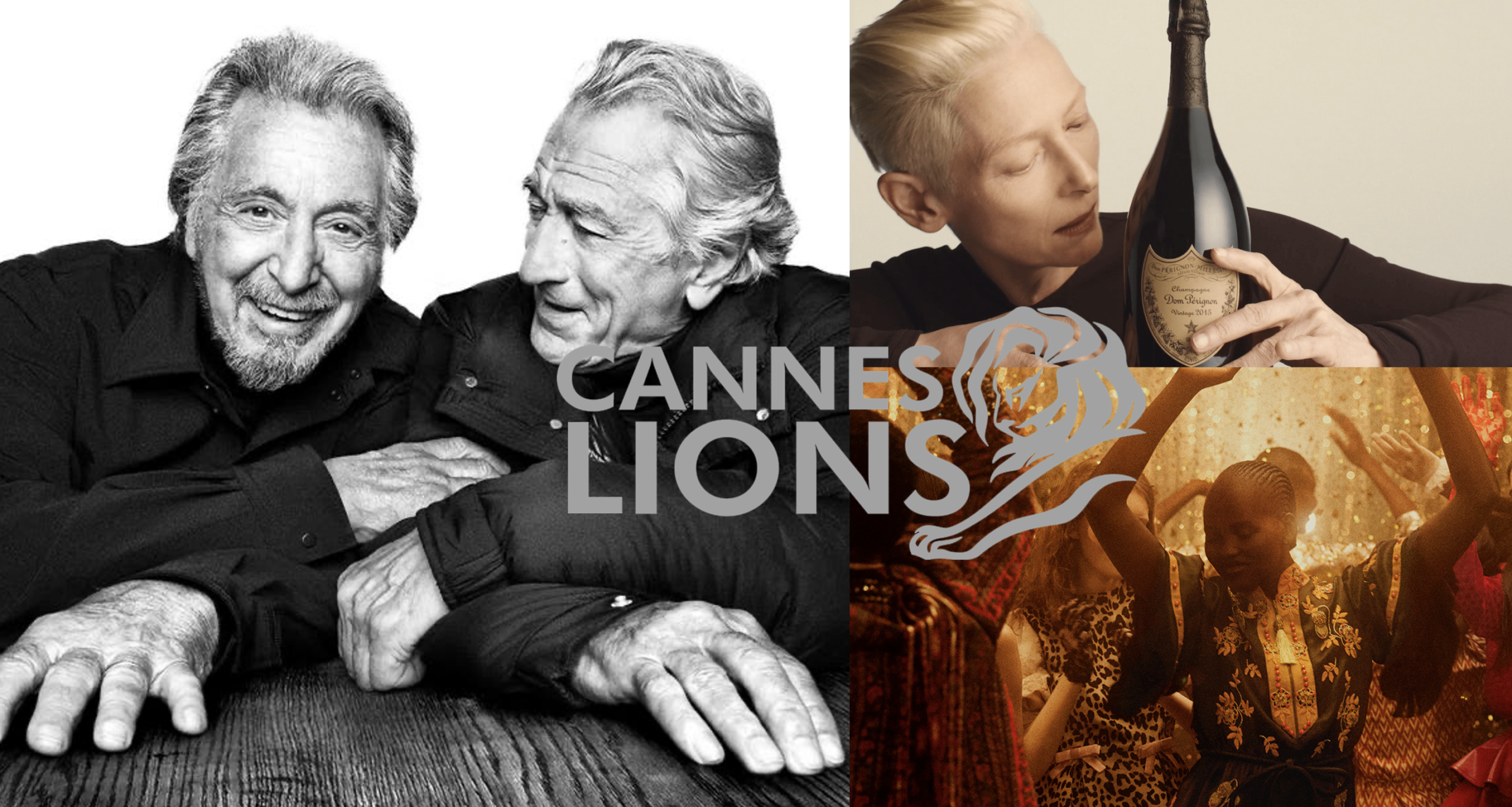
The 2026 Luxury Grand Prix went to Moncler for “Warmer Together” — a series of five intimate films and photographs featuring Al Pacino and Robert De Niro, shot in New York by portrait photographer Platon. Moncler’s largest ever campaign was, at its core, a study in the power of simplicity.
Jury president Pum Lefebure described the win precisely: the campaign succeeded because it stripped luxury storytelling down to a human truth — warmth, connection, loyalty between two old friends — and trusted that truth to carry the brand. The results confirm the bet: 85.4 million in net sales and a 48% year-on-year increase. Emotional clarity and commercial performance are not competing objectives.
What the Moncler win affirms is something luxury has always known, but which the AI era is making more urgent to articulate: in a world saturated with generated images and algorithmically optimised content, the capacity to produce something genuinely human — unhurried, intimate, felt — becomes one of the rarest and most powerful things a brand can offer. Luxury has the heritage, the craft, the depth of relationship to produce that. The task is to trust it.
WHAT THE LUXURY SHORTLIST REVEALED
The 13 shortlisted entries across nine subcategories — Experience, Sustainable Luxury, Craft, 360 Campaign, Brand Storytelling, Partnerships, Social Campaign, Diversity & Inclusion, and Commerce — illustrated how broadly the category is being asked to express itself.
“Born in Roma Rendez-Vous Ivory Collection / Studio 54 Experience” by Valentino Beauty showed a luxury brand doing something only the most confident brands attempt: reviving a legend. For one night only, the brand brought the iconic Studio 54 back to life — gathering beauty insiders, cultural changemakers, emerging creatives, and original patrons of that storied address for an immersive evening of scent, performance, and celebration. Beyond the collection itself, what Valentino was expressing is timeless: joy, the freedom to celebrate and express oneself, a sense of belonging — and an inclusive vision of luxury as a space where everyone is welcome. Tiffany & Co.’s “Mermaid” earned recognition in Sustainable Luxury, a subcategory that continues to grow in significance as the integrity of sourcing and materials becomes part of what clients are actually buying. Dom Pérignon, IWC Schaffhausen, and Nikka Whisky were each shortlisted in Craft — a reminder that technical mastery, when made visible, is still one of luxury’s most compelling languages. It is an infinite source of creativity.
Together, these entries reflect a luxury sector that is expanding the territory of what it means to matter: through excellence of product, but also through experience, purpose, and the quality and emotion of the world it invites its clients into. It highlights human connection, creativity and care.
WHAT OTHER SECTORS ARE TEACHING LUXURY
Perhaps the most instructive dimension of Cannes Lions is what the broader award landscape reveals about where culture and expectation are moving — and how closely those movements align with what luxury, at its best, has always practised.
Heineken’s “The Pub That Refused to Die” won the Creative Strategy Grand Prix. The campaign traced the story of the last remaining pub in the village of Kilteely, rescued by 26 residents who came together to purchase and reopen it. Heineken’s role was to amplify an act of belonging — a community’s refusal to let go of a place that held shared memory and ritual. The campaign resonated because it expressed something universal: belonging, ritual, and shared space are irreplaceable. Luxury has always understood this. The great houses did not build their desirability on product specifications alone — they built it on the feeling of entering a world, of being part of something that transcends the transaction. The Heineken win is a confirmation that this dimension of meaning — community, place, heritage, shared experience — carries more emotional weight than ever in an era when so much of life has been rendered frictionless and digital.
The Ordinary won the Health & Wellness Grand Prix for “The Periodic Fable” — a satirical campaign that replaced elements of the periodic table with meaningless beauty buzzwords to expose the hollow language saturating the industry. There is something worth noting about the courage this requires: The Ordinary critiqued the vocabulary of the industry it belongs to. At a moment when the dominant commercial pressure is toward more content, more claims, more optimised messaging, choosing to go against that current is itself a creative act. Sometimes creativity is exactly this: saying the uncomfortable truth, in the uncomfortable way, at the uncomfortable moment. For luxury, whose language of savoir-faire and heritage only carries weight when rooted in genuine knowledge, this is a confirmation of the founding principle: trust is built through honesty and real self-expression.
Adidas’s “Supernova Adaptive”, developed with TBWA\Canada in genuine collaboration with the Down syndrome community, won the Innovation Grand Prix. The shoe was co-designed, co-tested, and co-owned in narrative by the people it was made for — their bodies, their specific physical realities, their experience of movement.
This is, in essence, made to measure. And this principle — which luxury has practised for centuries, from Haute Couture to bespoke watchmaking — has never carried more meaning than now. In a world where algorithmic personalisation has made “customisation” a feature, genuine co-creation — the kind that begins with deep listening and ends with something made for a specific human reality — is one of the most powerful acts a brand can commit to. It is what transforms a product into an act of care. It is what gives creation its true value and meaning. For luxury, this is not a new lesson. It is a reminder of the original one — and a reason to hold it even more firmly.
AI AS INSTRUMENT, HUMAN AS WEALTH
Across the festival, artificial intelligence was the dominant conversation — and the most nuanced conclusion the work itself offered. The tone from panels, talks, and the awarded campaigns was consistent: AI amplifies creative capacity when directed by a clear identity, a genuine point of view, a living relationship with the people it serves. Deployed without those foundations, it accelerates sameness.
At Collins House during the festival, strategist Rory Sutherland observed: “Agencies nowadays are obsessed by scale. Nothing scales better than mediocrity.” Colette Phillip built on the argument: consolidation and one-size-fits-all thinking are eroding creativity. As larger organisations merge and optimise, independent agencies — and independent brands — compete through distinctive thinking, deeper cultural understanding, and closer relationships with the communities they serve. This is precisely what MAENA Agency defends: that the most powerful creative work comes from specificity, not scale.
This parallel runs directly through the week at VivaTech we analyzed the week before. There too, the work that carried meaning was the work rooted in genuine expertise: L’Oréal using AI to make 116 years of science more precise, not to replace it; Robertet using it to extend 175 years of perfumery craft into new territory. The pattern is identical across both festivals: technology in service of a clear identity creates meaning. Technology in place of identity creates noise.
Several of the most recognised campaigns at Cannes 2026 were built on analogue truth: a friendship filmed in New York, a pub in rural Ireland, shoes made with and for a specific community. What they share is the quality that AI cannot yet replicate — the sense that something human was at stake, and was expressed with care. As AI becomes more capable and more present, the human hand, the human connection, the human intention behind creation do not diminish in importance. They grow.
The Film Lions Grand Prix was awarded to two campaign films for Claude, positioned around an AI that pledges not to run commercial messages on its own tools. An AI company winning at a creativity festival by committing publicly to restraint. The message is resonant: in an era of infinite generation, what carries weight is choice — what you decide not to produce, not to optimise, not to scale. For luxury, this is familiar ground. The practice of making less, more carefully, with deeper intention is already embedded in what the sector stands for. The AI moment is making that practice more visible, more valuable, and more rare.
FRANCE: CREATIVE COUNTRY OF THE YEAR
France’s recognition as 2026 Creative Country of the Year is, simply, a pleasure to see confirmed. France is a country that overflows with creativity — in its ateliers and laboratories, its advertising agencies and cultural institutions, its independent studios and its great houses. 1,603 Lions, 39 Grands Prix, and a creative economy generating €92bn in annual revenue tell part of the story. Since 2020, the French government has invested €10bn across more than 20,000 creative businesses. President Macron’s video address to the festival tells another part: creativity is recognised here as a national strategic asset, not a soft skill.
This recognition is deserved — and it should be a source of genuine ambition, not just pride. France knows how to create things that matter: objects, fragrances, experiences, campaigns, films, ideas that people carry with them long after the first encounter. The goal is to continue doing this with conviction, and to do it in service of something larger than market share. To create real value for people. To contribute to a world that is, in some measurable way, more beautiful, more honest, more human.
That is what the best marketing has always been, and what luxury at its finest has always offered: not a scaling exercise, not an optimisation loop, but a human one. A capacity to make things that resonate, with lasting intention, in the service of a life well lived. France has always known this. Cannes Lions 2026 simply reminded the world.
THE QUESTION PREMIUM BRANDS MUST NOW ASK
Cannes Lions 2026 confirmed something that MAENA has long held at the centre of its work with brands: meaning is the most durable competitive advantage available.
Moncler won by expressing a human truth about friendship with unflinching simplicity. The Ordinary won by choosing honesty over optimised messaging. Adidas won by making something for a specific body, with specific people, through genuine co-creation. Heineken won by recognising, rather than inventing, a story of belonging.
Each of these wins affirms the same underlying logic: the brands that resonate most deeply are those that know what they stand for — and whose work is an honest expression of that, directed toward the things that genuinely matter to the people they serve. Heritage, human relationship, craft, the sense of belonging to something that exists beyond the transaction — these are the foundations of desirability that luxury has always built on. They are also the things that no algorithm can manufacture.
The opportunity for premium and luxury brands at this moment is not to reinvent their foundations. It is to articulate them with greater clarity, greater courage, and a deeper understanding of what they mean to the people who choose them.
The most enduring desirability is still built from meaning first.
Marine Moureaux-Gall / MAENA Agency