The evolution of male beauty is increasingly reflected in market performance. According to Euromonitor International, men’s grooming in France reached €1.86 billion in retail sales in 2025, growing by 2% year on year, despite declining demand in traditional shaving categories. Beyond overall market growth, the category is becoming more diversified. Mintel reported a 14.7% increase in men’s skincare product launches over the three years preceding February 2025, alongside a 12.3% rise in men’s hair treatments and colourants. In South Korea, where male beauty routines are more established, Euromonitor identifies skincare and fragrance as key drivers of growth through 2030. Together, these developments point towards a broader transformation: men’s grooming is progressively expanding beyond traditional hygiene and shaving into more sophisticated beauty routines, creating new opportunities for brands to rethink their portfolios, positioning and relationship with male consumers.
In 2018, Chanel introduced BOY DE CHANEL, its first makeup collection for men. Foundation, eyebrow definition and lip care entered a luxury beauty vocabulary that, for many Western consumers, remained strongly associated with women. Chanel described the initiative as an expression of its conviction that beauty concerns style rather than gender. Yet it had created a specifically masculine collection to communicate that belief.
The apparent contradiction was commercially astute. The product was not necessarily unfamiliar; the difficulty was giving a different consumer permission to use it. A dedicated identity could make complexion products approachable without asking men to negotiate the conventions of an established women’s beauty counter.
Eight years later, men’s participation in skincare, fragrance and cosmetics is more visible, but the category has not arrived at a single destination. South Korea offers a relatively mature model of everyday male beauty, while acceptance remains more uneven across Western markets. Meanwhile, online culture has made both self-care and appearance-related pressure harder to ignore.
The challenge also extends to communication. According to Mintel, over half of UK men believe that facial skincare advertising focuses too heavily on women. This highlights an important distinction: a product does not necessarily need to be gender-specific to make male consumers feel represented. Through more inclusive casting, relevant storytelling and accessible product education, brands can broaden their audience without systematically creating separate masculine ranges. For premium beauty, the opportunity lies in making men feel equally legitimate within the brand’s universe while preserving its distinctive identity.
For brands, the choice is therefore more substantial than whether to replace black packaging with neutral beige. When does a masculine identity help a consumer enter beauty, and when does it constrain the relationship that could develop afterwards? The answer affects portfolio architecture, brand positioning, education and the quality of the retail experience.
A MASCULINE LINE AS AN ENTRY POINT
BOY DE CHANEL demonstrated how cultural boundaries can be redrawn through the language of a house. Chanel translated its long-established willingness to question dress codes into cosmetics, but chose a clearly identified men’s line as the vehicle. It offered an intelligible route to products that some potential customers might otherwise have avoided.
That distinction matters. Men’s fragrance, shaving and haircare were familiar businesses long before male complexion products became more publicly visible. Makeup still required an additional explanation in many Western contexts. Naming the audience could remove friction at the point of discovery.
Yet such a structure creates a strategic question of its own. Once customers become comfortable using foundation or brow products, do they continue to require a separate range? Or might the product’s performance, finish and suitability eventually matter more than the gender printed on its packaging?
There is no reason to assume that gender-specific collections will inevitably disappear. Their role can change as a market develops: from reassurance for first-time users to an expression of an established brand universe. Brands should distinguish those functions before extending or retiring a range.
WHAT SOUTH KOREA REVEALS ABOUT NORMALISATION
South Korea provides a useful counterpoint to Western conversations that still frame men’s beauty as a novelty. Male skincare and discreet complexion correction have been visible there for years, supported by a sophisticated beauty industry and popular culture. The important lesson is not that every consumer behaves alike, but that everyday care can become a familiar part of masculinity.
In August and September 2024, CJ Olive Young’s first men’s beauty pop-up in Seoul attracted more than 12,000 visitors over ten days. According to The Korea Times, roughly 80 per cent were men. Visitors explored hybrid moisturisers offering hydration, SPF and tone correction, alongside naturally tinted lip products. These were accessible additions to familiar routines rather than theatrical statements about makeup.
Even in this context, discretion remained a product benefit for some shoppers. Greater cultural acceptance therefore need not produce a uniform aesthetic, nor does it eliminate dedicated men’s retail. The pop-up itself was explicitly labelled men’s beauty, despite operating in a more experienced market.
There is also no single ‘Asian consumer’. South Korea, Japan, China and Southeast Asia have distinct retail traditions and cultural expectations. A global brand should be wary of exporting a formula developed for one market as though it represented a regional truth. The better question is how confident customers already feel selecting products by need, and what kind of guidance still helps them.
MORE FREEDOM, BUT MORE APPEARANCE PRESSURE
The Western landscape is contradictory. In Mintel’s 2025 research on Germany, 44 per cent of men aged 16 to 34 said male makeup was acceptable. That finding points to an opening, but it also shows why a simple narrative of universal acceptance would be premature. Familiarity with skincare does not necessarily translate into comfort with every form of cosmetic expression.
Digital platforms have expanded access to practical grooming advice. A consumer can now find explanations of ingredients, techniques and routines without first visiting a beauty counter. Yet the same environment also circulates tightly defined ideas about what men’s faces and bodies should look like.
In a July 2026 discussion published by the American Psychological Association, psychologist Roberto Olivardia examined how social media and looksmaxxing communities shape boys’ and men’s perceptions of appearance. The discussion offers a useful distinction for beauty businesses: supporting an interest in self-care is different from marketing perpetual physical improvement as an obligation.
Beauty brands cannot control these wider conversations. They can, however, choose their own language. A measured explanation of hydration, sun protection or complexion benefits leaves room for personal preference. Communication built around deficiencies to be corrected may make new consumers feel that care is another test they must pass.
The opportunity is to develop confidence and lasting habits, with claims that products can substantiate. The industry’s experience with appearance pressure in other consumer segments should encourage care in the way it addresses this expanding audience.
WHY SOME BRANDS SHOULD REMAIN EXPLICITLY MASCULINE
Dior’s Sauvage Mencare shows the continuing strength of a dedicated architecture. The house has extended an established masculine fragrance universe into a cleanser, toner and facial serum, with cactus ingredients at the centre of its product story. The official range also includes hair products. Rather than introducing skincare through an unfamiliar identity, Dior uses a recognised franchise to invite existing clients into a broader ritual.
That is a different proposition from launching a generic ‘for men’ moisturiser. The name, olfactory associations and existing retail recognition already carry meaning. The extension can encourage category discovery while retaining continuity with Dior’s fragrance business.
Independent French brand Horace illustrates another model. Founded by Marc Briant-Terlet and Kim Mazzilli, it built an approachable men’s care universe around practical explanations, visible diversity in representation and advice. Horace explicitly welcomes men with different skin colours, body types and degrees of skincare experience. Its masculine positioning provides a recognisable setting without relying entirely on a narrow ideal of virility.
British independent Shakeup Cosmetics addresses an even more specific barrier. Founded by twin brothers Shane Carnell-Xu and Jake Xu, the company developed complexion and skincare products for men, including tinted moisturiser and concealer. Its commercial proposition makes discreet cosmetics legible through a vocabulary of male self-care.
These examples have different sources of authority: a luxury fragrance franchise, a service-oriented independent grooming brand and a specialist response to cosmetic hesitancy. Their strategies are not interchangeable, but they demonstrate that clearly masculine positioning can broaden participation when it removes genuine barriers. Gender should contribute something more meaningful than an interchangeable visual code.
THE CASE FOR A SHARED PORTFOLIO
Humanrace, founded by Pharrell Williams in 2020, starts from a different premise. Its stated philosophy does not differentiate by skin tone or gender, and its skincare and bodycare products are organised around a broader idea of intentional daily wellbeing. Ritual, design and product experience provide continuity in place of a gender-based product split.
Fenty Skin offers another expression of this approach. Its skincare proposition addresses skin types, texture, tone and the appearance of pores, with product communication centred on performance and routine. Consumers are invited through concerns and preferences rather than a men’s range sitting apart from the rest of the brand.
A shared architecture has practical advantages, especially for younger brands with finite resources. It can concentrate product-development investment, avoid unnecessary duplication and make it easier to communicate one clear proposition. It may also allow customers to move between products as their knowledge grows without crossing a category boundary.
None of this makes gender-neutral architecture intrinsically superior. It places greater demands on the clarity of the brand itself. Removing a gender label cannot substitute for recognisable design, credible expertise, an appropriate price structure or a compelling product experience. A brand that speaks to everyone in abstract terms may end up speaking meaningfully to no one.
The choice must begin with what the company can credibly own. A founder’s vision, formulation expertise, product sensoriality or distinctive service model may unite a broad audience. For another business, deep knowledge of a specific masculine customer journey may be its strongest competitive asset.
DESIGN FOR THE RELATIONSHIP, NOT THE STEREOTYPE
The more useful distinction for premium beauty may be between the product architecture and the route through which a consumer discovers it. A universal serum can be introduced through tailored men’s education; a clearly masculine fragrance franchise can still offer personalised advice rather than a one-size-fits-all ritual.
Brands should therefore ask separate questions about formulation, merchandising and communication. Does a product respond to a demonstrably different need, or is its gender distinction primarily a packaging decision? Can staff recommend products by skin concern and preferred finish? Does the customer need a dedicated destination, a more discreet consultation or simply confident advice in the main beauty space?
These are consequential choices. Dedicated ranges require their own inventory, innovation pipelines and communication investment. A unified offer may be simpler to manage, but it will not automatically reach a new male audience without suitable distribution, representation and education. Segmentation by familiarity, needs and behaviour can often reveal opportunities that a gender split obscures.
The strongest client experience should remain open to difference. A first-time buyer may appreciate direct guidance and an uncomplicated starter routine. An experienced customer may welcome an extensive product vocabulary and technical consultation. Neither profile can be defined by gender alone.
What makes the masculine turn significant is ultimately the expansion of legitimate ways to engage with beauty. Chanel anticipated the need for permission. Dior, Horace and Shakeup demonstrate the continuing value of dedicated entry points. Humanrace and Fenty Skin show how a shared proposition can build around care itself.
The next phase will reward brands that know why they use gender, rather than simply reproducing inherited codes. Masculinity may remain a valuable way into a beauty universe. It should not have to set the limits of how far a client can explore it.
Marine Moureaux-Gall / MAENA Agency
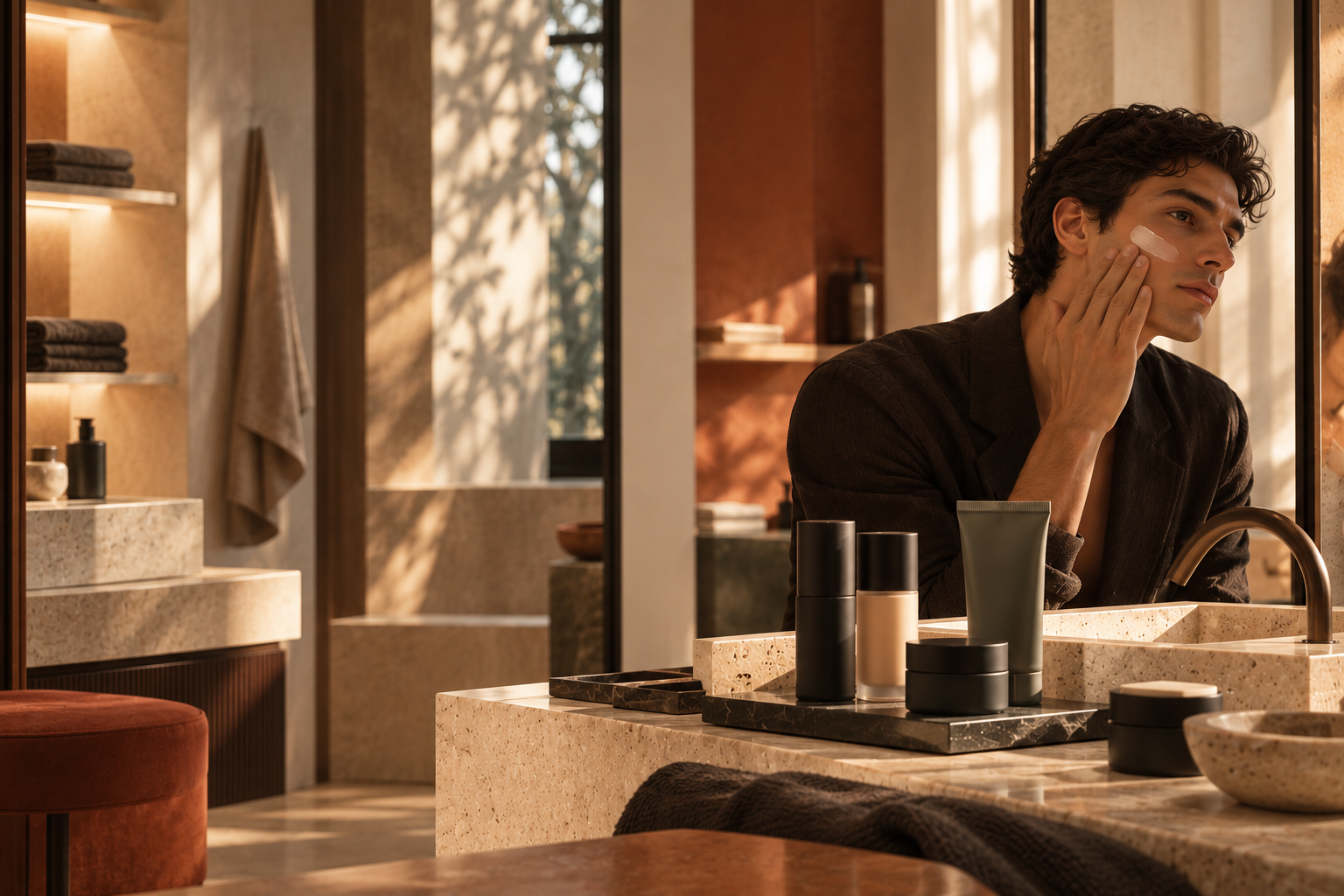
Featured image credit: AI-generated editorial visual, art-directed by MAENA Agency.