September has always been an important beauty month. Summer routines give way to autumn colour, fragrance returns to greater prominence, retailers reset their shelves and the final commercial stretch before the festive season begins.
Earlier this week, in The Luxury Rentrée: The Cost of Treating Everything as a Priority, we argued that the luxury rentrée should be treated as an exercise in discipline: when every September initiative receives the same emphasis, the client sees a calendar rather than a point of view. Beauty makes that challenge particularly visible. Here, the question is not only which launch should receive the greatest amplification, but why each new product exists in the first place.
This year, the density is particularly striking. BeautyMatter’s first launch round-up of September opened with new luxury fragrances from Prada, Chloé, Dolce & Gabbana and Balenciaga, alongside launches across skincare, make-up and beauty technology. In France, the same few weeks are bringing a succession of new fragrance and make-up propositions from major houses.
For consumers, the effect can be exhilarating and potentially confusing in equal measure. For beauty brands, it raises a more strategic question than how to win attention during a crowded month.
What is each new product actually there to do?
Beauty needs novelty. Discovery, colour, experimentation and the pleasure of finding something new are central to the category. But if September requires hierarchy at brand level, it also requires clarity at portfolio level. A launch creates lasting value when its role is legible: recruiting a different client, reactivating an established franchise, opening a new category, enriching a ritual, rewarding loyal customers or building an entirely new pillar for future growth.
When that purpose becomes difficult to identify, novelty risks adding choice without adding meaning.
EVERY NEW PRODUCT NEEDS A JOB
The beauty industry is particularly good at generating newness because its categories allow it. A fashion house cannot launch a new handbag silhouette every few weeks without eventually weakening the hierarchy of its icons. Beauty has considerably more flexibility: a shade can be seasonal, a fragrance can be intensified, a skincare product inserted into an existing routine, an established line extended through texture or format.
That flexibility is commercially valuable. It is also what makes portfolio discipline important.
A successful launch does not need to achieve everything simultaneously. Some products exist primarily to recruit. Others are designed for existing clients who already understand the brand. A limited-edition lipstick can create collectability without carrying the commercial expectations of a permanent franchise. A fragrance flanker can reactivate awareness around an established name. A new franchise has a much heavier task: it needs enough distinction and depth to support years of future development.
The relevant measure of innovation therefore changes according to the role of the product.
This matters even more when the retail environment becomes crowded. If several brands arrive within the same few weeks with new launches, stronger media investment alone cannot resolve every question of differentiation. The client needs to understand, sometimes almost instinctively, what has changed and why that change is worth discovering.
September 2026 offers an unusually useful set of examples because brands are pursuing very different answers.
WHEN THE PORTFOLIO NEEDS A NEW STORY: VALENTINO VENDETTA
Valentino Beauty’s Vendetta illustrates the most consequential form of novelty: creating a new franchise rather than another iteration of an existing one.
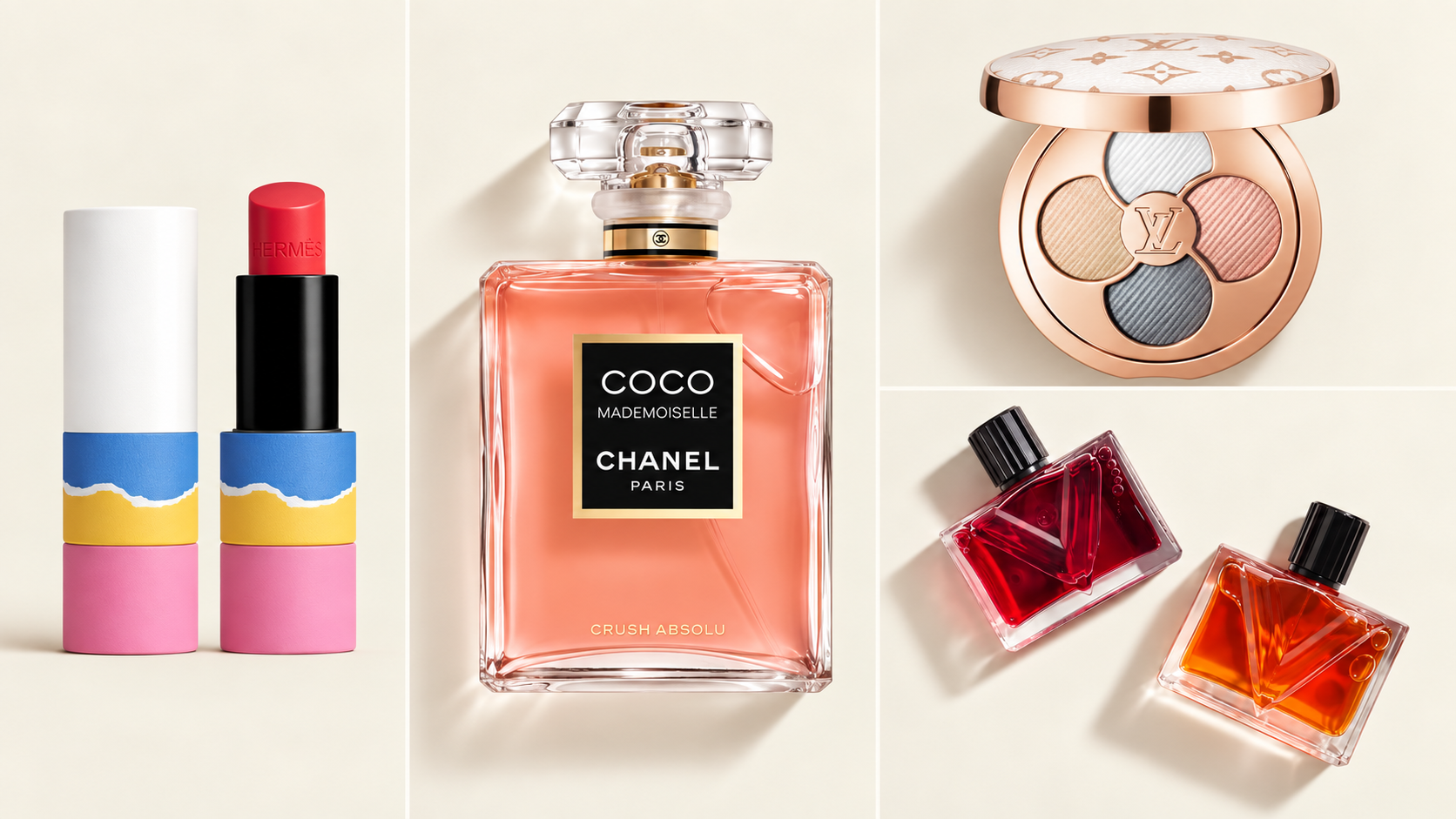
Introduced this summer and now entering its first major commercial season, Vendetta Donna and Vendetta Uomo constitute Valentino Beauty’s first new prestige fragrance franchise in six years. The name reaches back to a Valentino fragrance launched in 1991, while the current proposition creates a new dual universe around intimacy and emotional intensity. The bottles establish their own architecture through a strong V sculpted into the glass, while still drawing directly from Valentino’s couture identity.
That portfolio decision is important because Valentino already has an extensive Born in Roma universe. The house currently sells the original fragrances alongside Intense, Coral Fantasy, Extradose and the recent Purple Melancholia, among other expressions.
There is nothing inherently problematic about extending a successful franchise. Recognition reduces the work required to establish a completely new name, while different concentrations and olfactory interpretations can address different tastes and occasions.
Yet there comes a point when another version of an established franchise and a genuinely new pillar perform different strategic functions.
Vendetta gives Valentino Beauty room to create another visual identity, another emotional territory and potentially another long-term family of products. It also gives consumers a new entry point into the house rather than asking Born in Roma to carry every new fragrance story.
This is where portfolio management becomes creative strategy. A new launch earns its place when it expands what the brand can say, rather than simply increasing what the brand can sell.
WHEN NOVELTY MAKES AN ICON RICHER: CHANEL
Chanel is taking almost the opposite route with Coco Mademoiselle.
The fragrance was launched in 2001, making 2026 its twenty-fifth year. Rather than stepping away from one of its established signatures, the house is giving it a new interpretation with Coco Mademoiselle Crush Absolu. Olivier Polge retains patchouli as the olfactory link to the franchise, while introducing a lychee-grapefruit accord, rose and jasmine and a warmer amber treatment. Gracie Abrams becomes the face of this new chapter.
The more revealing decision sits alongside the fragrance. Chanel has also created a Coco Mademoiselle make-up collection, including a limited-edition Rouge Coco Crush. The house connects the lipstick to the fragrance universe, allowing one of its established olfactory signatures to travel into colour.
Here, novelty does not require a new universe. It makes an existing one broader.
Coco Mademoiselle already possesses recognition, an olfactory signature and a defined attitude. Transferring part of that identity into make-up creates additional ways to experience the franchise without asking consumers to learn another brand story from the beginning.
That distinction matters. Extension is strongest when the new product reveals another dimension of an asset that already has meaning. The result can strengthen memory around the original franchise because the pieces reinforce one another rather than compete for attention.
For established beauty brands with powerful icons, there is often more equity available inside what they already own than the launch calendar encourages them to believe.
A CODE CAN TRAVEL FURTHER THAN A CATEGORY: LOUIS VUITTON
Louis Vuitton provides another version of the same principle.
La Beauté Louis Vuitton is still a young category for the house, but its first limited-edition collection already reaches directly back into one of the brand’s oldest and most recognisable assets: the Monogram, celebrating its 130th anniversary.
The collaboration brings together Dame Pat McGrath, Cosmetics Creative Director, and Nicolas Ghesquière, Artistic Director of Women’s Collections. Two expressions Monogram Infrarouge and Monogram Dune, extend across eyeshadow, lipstick and lip balm.
The strategically interesting part is the direction of travel. Beauty is not developing at the edge of the Louis Vuitton universe with an unrelated language designed specifically for cosmetics. Instead, the new category is being connected back to an asset that clients already associate with the house.
That creates continuity between fashion and beauty while the latter is still establishing its legitimacy.
Luxury beauty increasingly offers fashion houses a relatively accessible way for clients to enter the brand. That makes coherence especially important. The lipstick or palette may be somebody’s first Louis Vuitton purchase; it still needs to carry enough of the house to make that encounter meaningful.
A proprietary code becomes particularly valuable when it can move between categories without becoming decorative. The Monogram does not simply identify the product as Louis Vuitton. It gives the beauty launch a history that the category itself has not yet had time to accumulate.
THE LAUNCH DOES NOT END WITH THE PRODUCT
Chloé’s approach to Le Nectar raises a different question: what happens when the product itself is intentionally familiar?
Le Nectar is an extension of Chloé’s Signature fragrance franchise. Rather than creating an entirely new bottle and name, the house builds from the recognition of an established line, giving this version a more gourmand treatment around neroli, tonka and patchouli.
On 9 September, Chloé and Nocibé supported the launch through a one-day Paris pop-up at La Patate Douce in the Marais. Drinks were created around the fragrances, samples distributed and the product placed inside a more social discovery experience than the conventional perfume counter.
For a flanker, this kind of activation performs useful strategic work.
The challenge is different from launching an unknown fragrance house or a completely new franchise. Consumers may already recognise the Chloé bottle and understand broadly what the brand represents. The objective is to make them look again.
Retail experience can create that interruption. It gives an existing franchise a temporary context, introduces the olfactory difference sensorially and turns what could otherwise appear as another variation on shelf into a reason for rediscovery.
This is especially relevant in fragrance, where the distinction between products is difficult to communicate through an image alone. The bottle can be photographed, the campaign can establish mood, but the central product difference still has to be smelled.
When September shelves are dense with newness, discovery needs enough time and space to happen. More launches therefore increase the importance of retail curation rather than reducing it.
A beauty advisor, pop-up, sampling ritual or clearly dedicated presentation can help consumers understand why a new reference exists. Without that layer, even a good product can become visually compressed into the wider volume of launch communication around it.
SOMETIMES LIMITED IS ENOUGH
Hermès shows why not every novelty needs a long future.
For autumn-winter 2026, the house has created a limited-edition make-up collection inspired by Scandinavian landscapes. Gregoris Pyrpylis translates the theme into lip colours, while Pierre Hardy treats the metal cases as small designed objects, with graphic landscapes of Arctic villages and snowy peaks.
The strategic role of such a product is quite different from Vendetta’s.
A seasonal Hermès lipstick does not need to establish a new multi-year franchise to justify its existence. Its temporality is part of its attraction. The colour can respond to a particular collection or creative inspiration; the object itself can reward clients who enjoy collecting Beauty Hermès editions; the limited duration gives the house permission to explore a visual territory that does not have to become permanent.
This kind of novelty serves loyalty and desire differently.
Beauty strategies sometimes place disproportionate emphasis on recruitment, particularly for products at more accessible luxury price points. Yet an existing client also needs reasons to return, discover and be surprised. A product conceived for that relationship can be commercially useful without pretending to address an entirely new consumer.
The discipline lies in acknowledging its role.
Limited editions become less meaningful when everything feels temporary, just as permanent portfolios become harder to navigate when every successful product produces a long succession of marginal variations. A clear hierarchy between icons, franchises, seasonal expressions and experiments helps the consumer read the brand.
It also gives each launch a fairer definition of success.
CLARITY IS THE STRONGER LAUNCH ADVANTAGE
September’s beauty rush is unlikely to disappear. The category depends on creative renewal, retailers need reasons to generate traffic and the months before Christmas remain commercially important. Nor should beauty become so disciplined that it loses the pleasure of experimentation.
Newness is part of the category’s emotional appeal. But novelty becomes strategically valuable when consumers can understand what it adds.
Earlier this week, the question was one of hierarchy: if everything is a priority during the luxury rentrée, the client receives a calendar rather than a point of view. Beauty adds a second layer of discipline. Even once a brand has decided what deserves amplification, each product still needs a reason to occupy the portfolio.
Valentino is creating room for a second major fragrance story. Chanel is using newness to deepen a twenty-five-year-old franchise. Louis Vuitton is making an emerging beauty category more recognisably its own. Chloé is giving consumers a reason to rediscover an established fragrance family through experience. Hermès is using limited edition as a creative and collectible proposition rather than asking every product to become permanent.
These are different objectives, and they should be.
Before adding another launch to an already crowded calendar, four questions are therefore more useful than asking whether the market needs more novelty: Who is this product for? What behaviour should it change? Which existing brand asset does it strengthen? And what would the portfolio genuinely lose if the product did not exist?
That final question is particularly demanding. It forces teams to separate a product with a distinct strategic role from one whose main justification is the availability of another launch window.
For premium beauty brands, especially those without the communication investment of the largest houses, this clarity can be a significant advantage. Fewer products with legible roles can create a stronger portfolio than constant novelty that requires ever more explanation.
There will always be another shade, texture, concentration, ingredient or format to explore. The creative possibilities of beauty are precisely what make the category so compelling.
September may test a brand’s ability to set priorities. In beauty, it also tests its ability to give every new product a clear reason to exist.
Marine Moureaux-Gall / MAENA Agency