Theme: luxury travel retail 2026
There are purchases we remember because of the object itself, and others because of where we were when we made them.
I still remember buying a beautiful pen for my father at an airport counter, a small gift that became inseparable from the journey around it. A bag bought at the end of a trip can carry the memory of that trip for years. I have also seen a colleague buy a pair of Chanel earrings almost entirely on impulse: she had not planned to shop, but the opportunity appeared at exactly the right moment.
None of these encounters followed the usual choreography of luxury retail. There was no planned appointment, no afternoon deliberately set aside for shopping. Yet that is precisely what makes travel retail so particular.
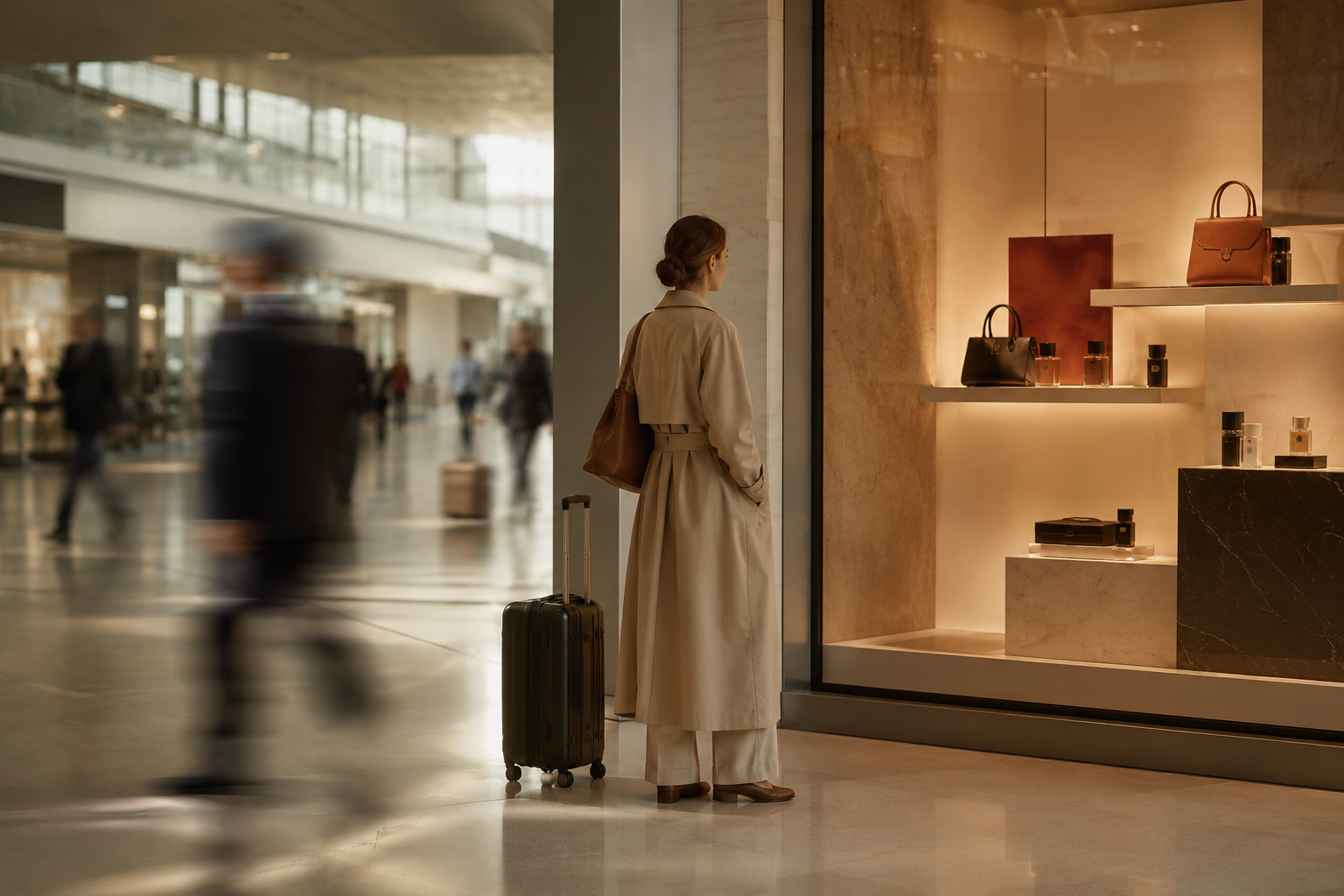
The traveller is temporarily outside routine. They have somewhere to go, but for a short period of time, often nowhere else to be. They may be tired, curious, celebratory, anxious, looking for a gift or simply open to distraction. Their relationship with time and attention is different.
For luxury brands, this creates an unusually valuable environment. High international traffic meets a captive audience at a moment when consumers may be more receptive to discovery than in everyday life. The channel can generate immediate sales, certainly. But its greater strategic potential lies in recruiting clients, testing ideas and creating an encounter memorable enough to continue after the journey.
Travel retail is, in many ways, a compressed version of the luxury experience. The brand has fewer minutes, less control and more competing stimuli. It must attract, explain, serve and sometimes convert almost instantaneously, without allowing that acceleration to make the experience feel transactional.
A CHANNEL IN TRANSITION, NOT IN DECLINE
The current travel retail landscape resists a simple narrative.
Avolta reported organic growth of 4.7% in the first quarter of 2026 despite disruption linked to the Middle East conflict; Asia-Pacific grew 17% organically. Yet the same disruption also exposed the channel’s vulnerability: when international mobility stops, part of the retail infrastructure stops with it. Source
Demand, however, has hardly disappeared. Dubai Duty Free generated a record US$2.378 billion in sales in 2025, up 9.85% year on year. Perfume remained its largest category, generating US$438.7 million and accounting for 18.45% of sales, while gold contributed US$245.6 million. These are categories naturally suited to travel: portable, giftable, discoverable within minutes and able to carry an emotional memory of place. Source
China tells another part of the story. According to Hainan’s Department of Commerce, offshore duty-free sales reached about US$3.4 billion in the first half of 2026, up 22.3% year on year. China Duty Free Group introduced 128 domestic and international brands and opened 28 new flagships over the same period. The island’s summer shopping festival is increasingly built around exclusive launches, premium customisation and immersive experiences connected to the wider tourism journey. Source
The structural changes are equally significant. In January, LVMH-owned DFS and China Tourism Group Duty Free announced an agreement for CTG Duty-Free to acquire DFS’s stores in Hong Kong and Macau, alongside certain Greater China intangible assets. LVMH and the Miller family also agreed to subscribe to CTG Duty-Free shares. A possible reading is not that luxury is retreating from travel retail, but that the channel is being reorganised around local scale, consumer knowledge and tighter integration between tourism and retail. Source
The old equation — international traveller plus tax advantage equals purchase — is no longer enough to explain the channel’s strategic value. Price still matters. So do convenience and traffic. But increasingly, so does the quality of the time a brand manages to capture.
THE TRAVELLER IS NOT A NORMAL SHOPPER
The same person can behave very differently when travelling.
A client who would not cross a city to visit a particular boutique may spend twenty minutes discovering that house while waiting for a flight. Someone who would normally compare an expensive purchase over several weeks may decide immediately because the object becomes linked to a place or occasion. Gifting becomes more spontaneous. A purchase can become a souvenir almost as quickly as it becomes a possession.
Travel also carries its own emotional states: anticipation and excitement, but also queues, delays, unfamiliar environments and fatigue. Entering a beautiful space, smelling a fragrance or simply receiving attentive service can offer a brief change of register. The luxury boutique becomes, for a few minutes, a pause.
This matters because travel retail may be one of the first physical encounters a consumer has with a house. In beauty and fragrance, sampling and sensory discovery can recruit younger or less familiar clients. In fashion, accessories and jewellery, the combination of availability and occasion can unlock purchases that were never planned.
The strategic measure of success should therefore extend beyond whether the traveller bought something that day. Did they discover the house? Did they understand something distinctive about it? Did they leave wanting to encounter it again?
TRAVEL RETAIL AS LUXURY’S LIVE LABORATORY
This is perhaps the channel’s most underused potential.
Because travel retail combines concentrated traffic with relatively contained formats, it offers brands an unusually visible environment in which to experiment. A pop-up can introduce a service, ritual, technology or new merchandising idea to thousands of international consumers without requiring the permanence of a flagship. The format can be agile. The execution is anything but simple.
At Madrid-Barajas, L’Oréal Travel Retail and Avolta created the Prada Beauty Spring Market, which ran until the end of June. Produce-style crates and fruit references brought a familiar market language into Prada’s visual world, while Beauty Advisors used shopping-list-shaped blotters to encourage fragrance discovery. The idea was contained, legible and built around interaction.
L’Occitane took a more sensory approach for its 50th anniversary. Across Paris Charles de Gaulle and Orly, its June activation translated Provençal ingredients into hand massages, olfactory discovery, a photobooth and a five-minute guided audio experience inspired by its spa treatments. The challenge was not to present everything the brand stands for, but to make its essence perceptible within the rhythm of an airport.
Estée Lauder’s global travel-retail launch of its new Double Wear foundation pushed the model further. Its Hainan “Playhouse of Dreams” included personalised consultations, shade matching, AI-powered photography and gamified discovery. Here, the pop-up becomes more than campaign theatre: it is a live test of which services actually create engagement and conversion.
That is the opportunity. A travel-retail pop-up should not simply be a miniature version of a global campaign. At its most useful, it can become a prototype. Brands can see what attracts attention, what people sample, what they ignore and what they are prepared to spend time doing. Few luxury environments offer such an immediate confrontation between creative intention and real consumer behaviour.
BEYOND THE POP-UP: THE AIRPORT AS A BRAND DESTINATION
Temporary activations are only one part of the equation. Permanent boutiques raise an even more interesting question: should an airport store reproduce the conventional luxury boutique, or should it respond specifically to the psychology of travel?
Chanel has just opened a standalone Fragrance & Beauty boutique at Toronto Pearson International Airport with Avolta. Alongside fragrance, skincare and makeup, the boutique includes travel-ready beauty sets and places personalised discovery at the centre of the experience. It positions the airport boutique as a distinct brand encounter rather than simply another point of distribution.
At Kuala Lumpur International Airport, Lacoste has introduced “Courtlines”, a concept developed specifically for travel retail and rooted in the house’s tennis heritage. The L.12.12 polo appears in cylindrical packaging inspired by tennis-ball tubes, while location-inspired patches can turn the purchase into a keepsake. Travel changes the way the product is presented without changing the source of the brand idea.
Cartier’s refurbished boutique at Incheon Airport similarly integrates Korean architectural tones and materials, including a design reference to the curves of the Incheon Bridge, while remaining immediately recognisable as Cartier.
Nice Côte d’Azur Airport has taken the same thinking to the scale of an entire retail environment. Following an eighteen-month transformation, around 6,300 square metres of retail and service space have been renewed around an ambition to express the French Riviera through luxury, niche perfumery, Mediterranean craftsmanship and local products.
The strongest travel retail does not need to feel placeless. An airport may serve an international audience, but that does not require a globally standardised experience. A boutique in transit should still belong unmistakably to the house. It can also belong, in some way, to the journey.
THE HARDEST VERSION OF LUXURY SERVICE
There is, however, an operational reality behind these increasingly sophisticated experiences.
Travel retail can be one of the hardest environments in which to deliver consistent luxury service. Depending on the retail and concession model, advisors may not always work exclusively for one brand. Staff rotations, multilingual customers, unpredictable passenger flows and compressed interaction times add layers of complexity. A pop-up may have enormous visibility while giving the brand less control than its own directly operated boutique.
The consumer sees none of this. They see the house.
A distracted interaction, a poorly explained product or an indifferent welcome is still attributed to the brand whose name sits above the counter. The experience must therefore be condensed without becoming rushed. The advisor has to understand quickly whether the traveller wants to discover, purchase, browse or simply breathe for a moment.
Technology can help through diagnostics, clienteling tools and faster access to information. But service remains profoundly human. Sometimes the most memorable gesture is remarkably small: a thoughtful gift, a sample selected because the advisor listened, a beautifully wrapped purchase when time is short.
The experience does not always need to be spectacular to be remembered. In an environment designed around movement, making someone feel considered may be the most luxurious act of all.
A FASTER ENVIRONMENT NEEDS BETTER MEASURES OF SUCCESS
Travel retail is inherently measurable. Brands can monitor traffic, conversion, average basket size, dwell time, sampling and performance by nationality or destination. But the most interesting KPIs may increasingly sit beyond the transaction.
How many buyers are new to the brand? Which services create genuine engagement? Does a traveller who first encounters the house in Hainan, Heathrow or Dubai later purchase from it at home? Can that relationship continue after the boarding gate closes?
The operators themselves are moving in this direction. By late June 2026, Club Avolta had more than 18 million members worldwide across duty-free, duty-paid and food and beverage. The ambition is clear: connect behaviour across the journey, understand travellers better and make the relationship less dependent on a single transaction.
For luxury houses, the same principle matters. The highest-value outcome of a travel-retail encounter may not always be the largest basket that day. It may be the first purchase from someone who remains with the house for years.
WHEN THE JOURNEY BECOMES THE BEGINNING
Travel retail has often been treated as a specialist distribution channel operating alongside domestic retail, e-commerce and wholesale. It deserves a more ambitious role.
Few environments combine international visibility, high traffic, available time, emotion, gifting, impulse and discovery in quite the same way. Fewer still allow brands to test ideas with such immediacy across such diverse consumer profiles.
The challenge is to resist treating that captive audience as guaranteed demand. A traveller may have time, but their attention still has to be earned. They may make an impulsive purchase, but the quality of that encounter will determine whether the object remains a one-off souvenir or becomes the beginning of something longer.
For luxury, that means identifying what must survive when the usual experience is compressed: the code, the story, the expertise, the quality of service, the gesture that makes a person feel recognised. Then making it immediately perceptible.
The most valuable travel retail experience may ultimately be the one that survives the journey itself: a discovery remembered, a gesture retained, or a first purchase that becomes the beginning of a longer relationship with the house.
Because the traveller may only be passing through. The brand does not have to.
Marine Moureaux-Gall / MAENA Agency
Featured image credit: AI-generated editorial visual, art-directed by MAENA Agency.