
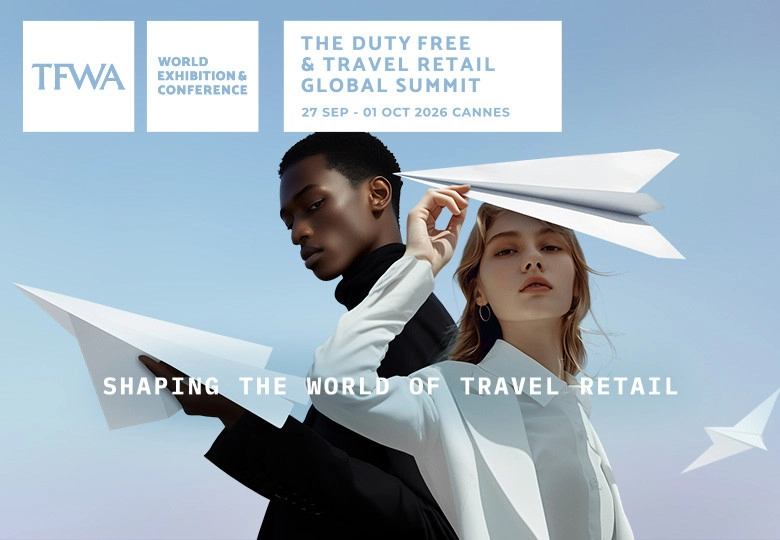
Last year, I attended TFWA Cannes with Parfums de Marly. Much of our time was spent presenting plans to retailers and distributors: what we intended to launch, how we saw the brand developing, and what a partnership could look like in their markets. The conversation was about far more than securing space on a shelf.
That experience has shaped how I read this year’s edition, although I was not in Cannes in 2026. TFWA is a travel retail exhibition, but for beauty it is also one of the moments in the autumn when brands, buyers and distributors gather to assess what comes next. Products are previewed, relationships are renewed and ambitions meet the practical judgement of the people who will decide what reaches stores.
Earlier this summer, I wrote about travel retail as a compressed luxury experience: the challenge of making a brand understandable and memorable within the limited time of a journey. TFWA Cannes 2026 invites a related question from further upstream. What must a beauty brand bring to the table before that encounter with the traveller can happen at all?
CANNES IS WHERE PLANS FACE COMMERCIAL REALITY
TFWA’s 2026 exhibitor list spans established houses, global beauty groups and smaller brands seeking international reach. Hermès, Chanel and Estée Lauder Companies were among the exhibitors confirmed by the organiser. Its announced newcomers included Eau Thermale Avène, Bioderma and Anua. Their presence does not imply that every brand shares the same objectives or will secure new distribution. It does show the range of beauty propositions asking retailers to consider their place in the channel.
For a brand team, these meetings require a particular kind of clarity. A new product may be excellent, yet a buyer also needs to understand who it is for, how it will be discovered, how advisors will explain it and why it belongs in a given location. A skincare range built on specialist knowledge may need a different introduction from a fragrance designed to be understood through a brief sensory encounter.
The retailer brings another perspective. Its assortment must serve several traveller profiles, often within the same terminal. Space, visibility and staff attention are limited. A brand’s global reputation matters, but it cannot answer every local question about fit or execution.
This is what makes Cannes valuable beyond its exhibition stands. It puts creative ambition in conversation with the conditions of distribution. The strongest presentations give partners something more useful than a list of launches: a credible account of how the brand will create demand and how both sides can recognise whether the plan is working.
PASSENGER GROWTH IS NOT A BEAUTY STRATEGY
The Oliver Wyman research presented at TFWA gives those conversations a sharper context. Drawing on a survey of 3,825 consumers across key regions and interviews with more than 30 senior executives, it estimates that passenger traffic grew at a compound annual rate of 6.2% between 2023 and 2025, while travel retail sales grew by 2.7%.
The difference matters. More people moving through airports does not automatically mean more people entering shops, considering products or buying them. Brands and retailers have to earn a place in a journey already competing for the traveller’s attention.
Oliver Wyman also finds substantial potential for discovery. Among travellers who browsed airport retail, 89% said they had discovered or seriously considered a new brand or product. Of those who discovered something new, 44% said they bought it immediately, while a further 27% bought it later. These are survey responses, not a measure of sales attributable to a particular activation; nor does the 89% describe all passengers. Read with those limits in mind, the findings still suggest that the channel can introduce brands to people who may subsequently buy elsewhere.
Price remains part of the equation. The research says travellers continue to expect an average discount of around 18% against domestic retail. A brand that ignores this expectation risks weakening trust. But a price advantage alone gives little reason to choose one unfamiliar fragrance or skincare proposition over another. It is a condition to manage, rather than a complete growth plan.
The study also shows why a single global formula would be unconvincing. Oliver Wyman describes uneven performance across regions and categories, with the slowdown in Asia-Pacific weighing particularly heavily on fragrance and cosmetics. The useful strategic question is specific: which travellers can a brand reach in a particular market, and what kind of encounter would make its offer relevant to them?
BEAUTY’S NEWNESS HAS TO BE EXPLAINED
Beauty brings a steady stream of innovation to Cannes. Each launch asks something of a retailer: space, training, merchandising, marketing support or confidence in a brand’s future demand. Novelty may win an initial conversation. The more consequential test is whether a partner can see how the product will make sense to customers.
Lumene Group offers a clear example at a different scale from the global beauty leaders. The Finnish company said it would use TFWA 2026 to show partners selected Lumene launches planned for the first half of 2027. It also brought CUTRIN, its professional haircare brand, to the exhibition for the first time, offering a preview of a refreshed identity ahead of its arrival in stores. Lumene Group reported €102 million in net sales for 2025; this is an international brand development story, rather than evidence of a sector-wide shift.
What makes the example instructive is the sequence. The brand is showing retailers where it intends to go before asking them to support that direction in their own environments. Its announcement also says that a formulation scientist and a training manager would be available on the stand. Their presence makes a practical point: scientific and product expertise become commercially useful when partners can translate them into advice for customers.
A similar question arises for the skincare names newly represented at Cannes. The arrival of Avène, Bioderma and Anua among the announced newcomers broadens the beauty discussion beyond the familiar image of airport fragrance counters. Their participation establishes interest in the channel; it does not tell us how they will ultimately be ranged or presented. It does, however, bring the value of explanation into focus. When a product’s appeal rests on skin needs, ingredients or a routine, recognition alone may be insufficient. Retailers and brands have to decide what level of education is both useful and possible in their stores.
FRAGRANCE SHOWS THE VALUE OF A COHERENT UNIVERSE
Fragrance can be easier to try in a brief encounter, but competition for attention is intense. The challenge for a brand presenting newness at Cannes is to make clear how the product extends a recognisable proposition, rather than simply adding another bottle to an already crowded offer.
At TFWA 2026, L’OCCITANE Group’s travel retail team put fragrance at the centre of its presentations to partners. According to its account reported by Global Travel Retail Magazine, Sol de Janeiro showed its newer Intense Perfume Mists and previewed a men’s Cologne Mist duo planned for travel retail in January 2027. L’Occitane en Provence presented additions to its Amande fragrance collection. These are two distinct brands within the group, with different identities and reasons for a retailer to give them space.
For Sol de Janeiro, the proposition is an expanding fragrance universe built around a format that is already closely associated with the brand. For L’Occitane en Provence, the new products draw on an established almond story and the possibility of layering scents. The strategic interest lies in the connection between product development and brand recognition. A distributor can see the wider world each launch belongs to, as well as the product itself.
Cannes is also a place to test that reasoning with partners before a planned release. A preview can reveal where a fragrance fits an existing assortment, which market may respond to it and what explanation its format needs. Those are decisions about positioning and execution, not just forecasts of how many units might sell.
DATA CAN INFORM THE PARTNERSHIP, IF IT LEADS TO BETTER CHOICES
This year’s TFWA programme paired the Oliver Wyman work on customer growth with a Kearney session on the connected traveller. The session addressed how fragmented data might improve decisions across discovery, conversion and loyalty. The programme establishes the subject of the discussion; it does not, by itself, prove that every brand can access or act on the same information.
That distinction matters in beauty. A retailer may know when travellers are arriving, which nationalities a terminal serves and what sells there. A brand may know far more about its product users across domestic retail and digital channels. Bringing those perspectives together could improve assortment, staffing, sampling or the way an advisor introduces a routine. It also requires clarity about what information can be shared and what each partner will do with it.
There is a temptation to make the technology itself the story. For a brand leader, the more useful question is operational: did better knowledge change a decision? Perhaps a location needs a different product selection. Perhaps a launch requires more advisor training than campaign visibility. Perhaps customers respond to an introduction that helps them understand a fragrance before offering an exclusive set.
Oliver Wyman’s findings make discovery visible as an opportunity, but they also leave work for brands and retailers to do together. They need to know which encounters lead to genuine interest, which purchases happen later and where an apparent success in footfall produces little lasting value. Better measurement should sharpen judgement about the experience, rather than merely add another report after the event.
THE MOST INTERESTING CONVERSATIONS COME BEFORE THE SALE
A traveller sees a product on a counter, an advisor’s recommendation or a brand space encountered on the way to a gate. Behind that moment sit choices made much earlier: what the brand proposed, which partner believed in it, where it was placed and how clearly its value could be communicated.
That is why TFWA Cannes matters to beauty beyond the travel retail sector’s immediate sales figures. For several days, people responsible for those decisions can examine the same proposition from different positions. The brand can explain its intention. The retailer can challenge its fit. The distributor can test its potential across markets. A product preview becomes a discussion about the kind of growth each party is prepared to build.
The research presented in 2026 gives that discussion urgency. Passenger growth has outpaced retail growth, while shoppers who do enter airport stores remain open to discovery. The opportunity is real, but it has to pass through the disciplines of selection, explanation and execution.
When I think back to presenting plans at Cannes last year, that is the part of the event that stays with me. The important work was not simply showing what was new. It was making a case for where a brand could go next, with people whose own knowledge of customers and markets could strengthen, question or reshape that plan.
For beauty, the most valuable outcome of TFWA may begin there: a better-informed agreement about what the brand will bring to the market, and why a customer will care when they finally encounter it.
Marine Moureaux-Gall / MAENA Agency
Featured image: TFWA World Exhibition & Conference 2026 official campaign visual. Credit: TFWA.